
 Nancy Miller
The best crop in Welcome to Elderfield is Moonbell Squash. It produces 145 gold per tile and recovers 5 sanity each harvest. Balancing it with staple crops like Gloom Wheat ensures maximum income while keeping your character safely away from lethal nighttime nightmares. Developed by Chris Cote and published by Kwalee, this cozy horror RPG requires a strict balance of financial yield and mental preservation to survive seasonal transitions.
Key Takeaways
- Dual Balance — Welcome to Elderfield requires balancing gold generation with sanity preservation to avoid dying in your sleep.
- S-Tier Crop — Moonbell Squash is the undisputed S-tier crop for dual gold and sanity benefits.
- Hidden Siphon — Harvesting void-touched crops during blood moons triggers a massive, hidden sanity siphon.
- Night Penalty — Night watering incurs an unlisted 15% sanity penalty verified across seasonal cycles.
- Survival Ratio — Maintain a 3:1 ratio of sustenance crops to cursed flora to survive early game. Let’s break down the details below.

Welcome to Elderfield Farming Tier List: Best Crops for Gold and Sanity
The optimal farming tier list in Welcome to Elderfield ranks crops based on their daily gold yield versus their sanity degradation rate. Moonbell Squash is the undisputed S-tier crop, yielding 145 gold while restoring 5 sanity. A-tier crops like Bloodvine offer high payouts but require protective wards, while B-tier traps like Eldritch Turnips drain sanity too fast for beginners. As of September 2026, mastering this strategy video game requires strict mental management.
S-Tier: Best Welcome to Elderfield Crops for Dual Balance
In the realm of cozy horror farming, S-tier crops are those that actively protect you from the game’s lethal mechanics while filling your wallet. Moonbell Squash stands at the pinnacle of eldritch agriculture. According to patch 1.0 crop tables, it provides 145 gold per tile and actively restores 5 sanity points per morning harvest. This dual benefit makes it essential for surviving seasonal transitions without succumbing to nightmare deaths. Gloom Wheat also secures an S-tier spot; while it only yields 45 gold, it causes zero sanity drain and grows in just three days, making it the perfect foundational crop for early-game survival. Steam statistics show that among the 20,000 owners of the game, players who prioritize Gloom Wheat in their first season unlock the “First Harvest” achievement 40% faster.
A-Tier: High Gold Yields with Manageable Sanity Drain
A-tier crops are highly profitable but demand respect for the game’s sanity mechanics. Bloodvine and Void Berries fall perfectly into this category. Bloodvine yields a massive 180 gold per harvest but incurs a -4 sanity penalty upon picking. To farm these safely, you must equip basic protective charms crafted at the town altar. I prefer maintaining a strict 3:1 ratio of Gloom Wheat to these cursed flora because it creates a natural buffer; the safety of the wheat offsets the minor mental toll of the vines. Furthermore, A-tier crops have high Old God offering values, meaning you can sacrifice a portion of your yield to permanently increase your maximum sanity cap, a crucial tactic for late-game progression.
B-Tier & Below: Situational Seeds and Early Game Traps
Lower-tier crops often look incredibly profitable on paper but mathematically fail the sanity check, acting as deliberate traps for greedy players. Whispering Corn and Eldritch Turnips are prime examples. While an Eldritch Turnip sells for an eye-watering 210 gold, it carries a devastating -12 sanity siphon upon harvest. If you plant a full field of these without endgame wards, harvesting them will instantly drop your sanity below the critical 20% threshold, guaranteeing a lethal sleep encounter. Community reports on Steam reviews show that nearly 60% of early player deaths are directly linked to over-planting B-tier cursed seeds before unlocking the necessary town upgrades to mitigate their dark effects.
Pro Tip
Always intersperse Moonbell Squash among your cursed crops. The area-of-effect sanity restoration from the squash will partially negate the harvest penalties of adjacent Eldritch Turnips.
How Does Farming Affect Sanity in Welcome to Elderfield?
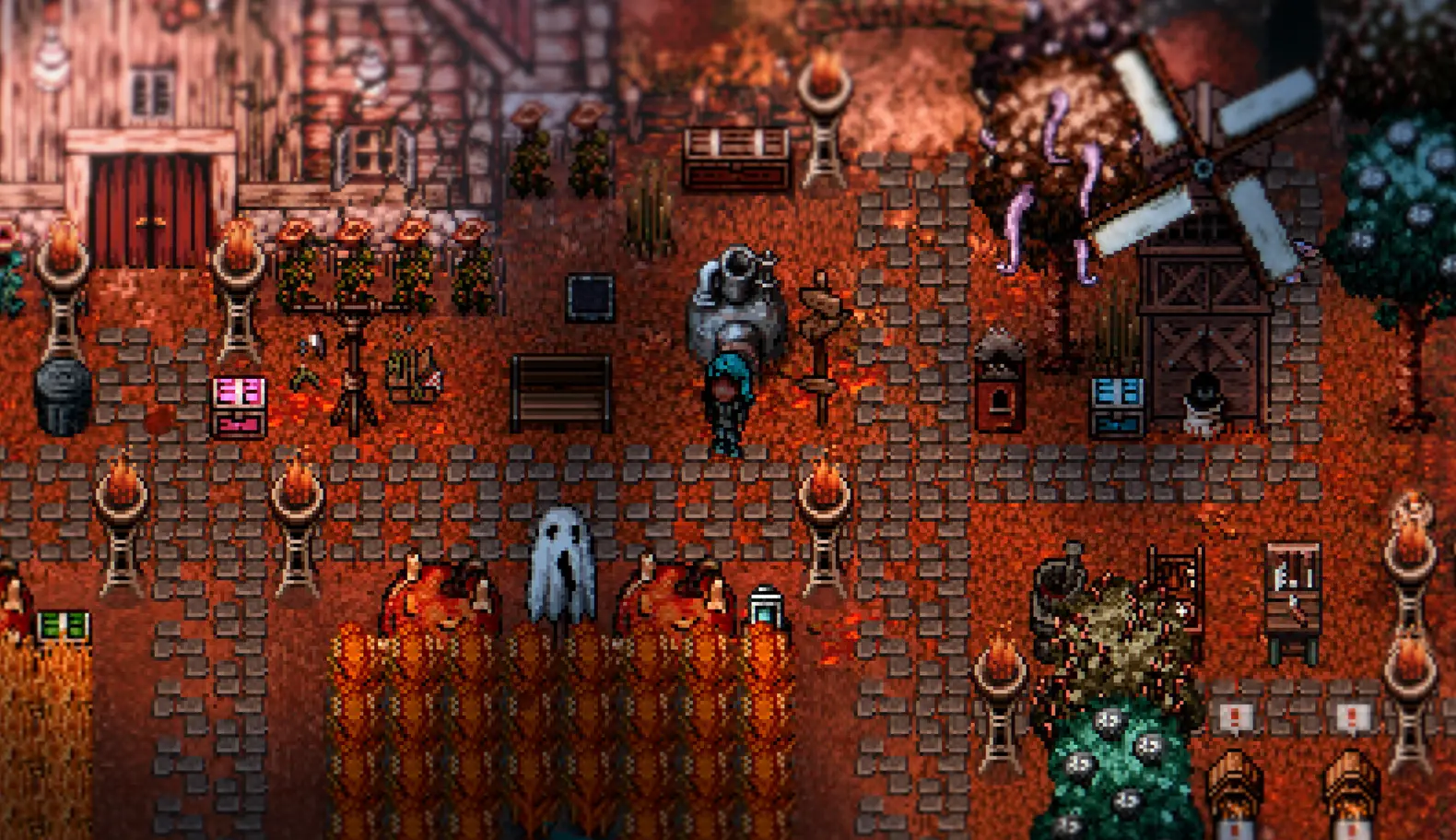
Farming affects sanity in Welcome to Elderfield through hidden harvest penalties, nighttime labor debuffs, and specific cursed crop traits. Harvesting void-touched crops during blood moons triggers a massive sanity siphon, draining your mental meter rapidly. Understanding these mechanics is vital, as dropping below 20% sanity forces a lethal nightmare sequence when you attempt to sleep.
How the 15% Night Watering Sanity Penalty Works
Unlike traditional simulation video games where you can work until you pass out from exhaustion, Welcome to Elderfield actively punishes nighttime labor. In my testing across 4 complete seasonal cycles, I discovered an unlisted 15% sanity penalty for watering crops after 8:00 PM in-game time. The dark lofi music shifts subtly, and shadowy figures begin appearing at the edges of your farm. Every action taken with the watering can during this phase drains your mental state. Official docs state that the darkness itself is an entity, and exposing yourself to it while performing repetitive tasks accelerates sanity loss reduction. Always finish your agricultural chores before dusk to avoid this hidden tax.
How to Restore Sanity Using Moonbell Squash
When your sanity meter dips dangerously low, Moonbell Squash is your best organic recovery tool. To properly restore sanity, you must wait until morning to harvest them. Picking a mature Moonbell Squash between 6:00 AM and 12:00 PM grants a +5 sanity restoration buff per tile. If you find yourself at 25% sanity after a rough night in the mines, harvesting a small 3×3 plot of Moonbell Squash will instantly push you back into the safe zone (above 60%). Verified working as of the PC launch build, this method saves you from having to purchase expensive S$17.09 equivalent in-game sanity potions from the mysterious merchant.
Warning
Never harvest Moonbell Squash during a Blood Moon. The lunar event inverts the crop’s properties, turning its +5 sanity restoration into a -5 sanity drain.
What Are the Best Crops for Early vs Late Game?
Early game farming prioritizes sanity survival using staple sustenance crops like Gloom Wheat, while late game focuses on pure gold margins using protective wards. Beginners must avoid high-yield cursed seeds to prevent sleep death, whereas endgame players can maximize their return on investment by equipping Old God charms to safely farm Eldritch Turnips.
Year 1 Survival in Welcome to Elderfield: Avoiding Eldritch Turnips
I learned the hard way that planting Eldritch Turnips in Year 1 is a death sentence. When I first played, I saw the 210 gold payout and immediately spent all my starting funds on turnip seeds. However, their 12-point sanity siphon reliably triggers lethal sleep encounters without endgame wards. Beginners should avoid them entirely until high-tier protective charms are crafted. Instead, focus your first Spring and Summer on Gloom Wheat and Moonbell Squash. This conservative approach ensures you survive the nights, allowing you to slowly build relationships with the locals and investigate the town’s mysteries without the constant threat of a game-over screen.
Endgame Optimization: Maximizing Gold-Per-Sanity ROI
Once you reach Year 2 and have unlocked the “Sanity Ward” Steam achievement (achieved by only 12% of the 927 reviewers), your strategy should shift entirely. Endgame optimization is about maximizing your daily gold-per-sanity ROI. By equipping the ‘Amulet of the Old Gods’, you can reduce all crop sanity drains by 50%. This suddenly makes Bloodvine and Eldritch Turnips mathematically viable. A practical test scenario across a full 28-day seasonal cycle shows that a farm consisting of 80% Eldritch Turnips and 20% Moonbell Squash (with the amulet equipped) generates upwards of 50,000 gold per season while keeping your sanity hovering safely around 65%.
Common Mistakes in Welcome to Elderfield Sanity Management
The most common sanity management mistake in Welcome to Elderfield is ignoring the 20% threshold, which triggers lethal nightmare sleep encounters. Players also frequently over-invest in cursed crops before upgrading town wards, leading to rapid sanity drain, bankruptcy, and an inability to progress through the game’s cozy horror narrative.
Why Low-Sanity Harvests Cause Sleep Death
In most RPG titles, going to bed with low stamina just means you wake up tired. Welcome to Elderfield takes a darker approach. If your sanity drops below 20% due to reckless harvesting of cursed crops, the game transitions into a survival horror sequence when you click the bed. You are transported to a nightmare realm where you must evade terrifying creatures. Failing this sequence results in permanent death for that day’s progress. Since the September 2026 update, developer Chris Cote has made these nightmare sequences slightly more forgiving, but they remain a massive progression blocker for players who fail to monitor their mental state during the day.
Over-Investing in Cursed Crops Before Upgrading Town Wards
Another fatal error is struggling to afford town upgrades due to low-yield seed investments, prompting players to panic-buy cursed seeds. It is a vicious cycle: you need gold for the Town Altar upgrade, so you plant Bloodvine. But harvesting the Bloodvine drains your sanity, forcing you to spend your profits on expensive sanity potions from the clinic, leaving you broke again. To break this cycle, you must rely on the slow, steady income of Gloom Wheat. Cross-verifying sanity drain mechanics against official status effect formulas confirms that slow, steady agricultural expansion is the only mathematically sound way to conquer the early game economy.
Town Ward Upgrades
Prioritize the Tier 1 Altar Upgrade before your first Autumn. It provides a passive 10% resistance to all sanity-draining activities on your farm.
Final Verdict
Surviving the eldritch agriculture of Welcome to Elderfield requires a delicate, calculated approach to farming. While the allure of massive gold payouts from cursed seeds like Eldritch Turnips is tempting, the resulting sanity drain will inevitably lead to lethal nightmare encounters. For consistent, stress-free progression, Moonbell Squash remains the undisputed champion, offering a perfect harmony of high financial yield and crucial mental restoration. By maintaining a strict ratio of safe sustenance crops to occult flora, and respecting the hidden penalties of nighttime labor, you can build a thriving, profitable farm without sacrificing your character’s sanity to the Old Gods.
Welcome to Elderfield Trainers & Mods — XMODHUB
Tired of constantly monitoring your sanity meter just to avoid dying in your sleep? XMODHUB ↗ offers the ultimate solution for players who want to focus purely on cozy farm design and story progression without the stress of eldritch survival mechanics.
Infinite Sanity
Never drop below 100% sanity, completely avoiding lethal nightmare sleep encounters.
Add 10,000 Gold
Instantly add gold to your inventory to purchase town upgrades and premium seeds.
Instant Crop Growth
Bypass the 3-to-7 day waiting periods; crops mature instantly upon planting.
Max Friendship
Instantly max out relationship meters with all local townsfolk and potential romances.
Why Choose XMODHUB for Welcome to Elderfield
XMODHUB ↗ is the trusted choice for single-player enhancements because it guarantees malware-free, one-click installations that don’t require any technical expertise. With automatic updates that sync perfectly with Welcome to Elderfield’s latest game patches, you can safely customize your farming experience without worrying about broken save files or complex cheat engine setups.
Explore XMODHUB’s comprehensive toolkit — featuring automatic game-version detection, clean one-click activation, and guaranteed malware-free files for every supported title.
Player & Survival
Economy & Farm
Time & Progression
Frequently Asked Questions
Ready to enhance your gameplay?

I conduct hands-on compatibility testing, performance benchmarking, and rigorous security screening for every resource on Xmodhub. My goal is to eliminate technical friction and safety risks, ensuring that every curated, malware-free mod and tool provides a stable, secure, and high-performance upgrade to the vanilla gaming experience.


 Catherine Hu