
 Catherine Hu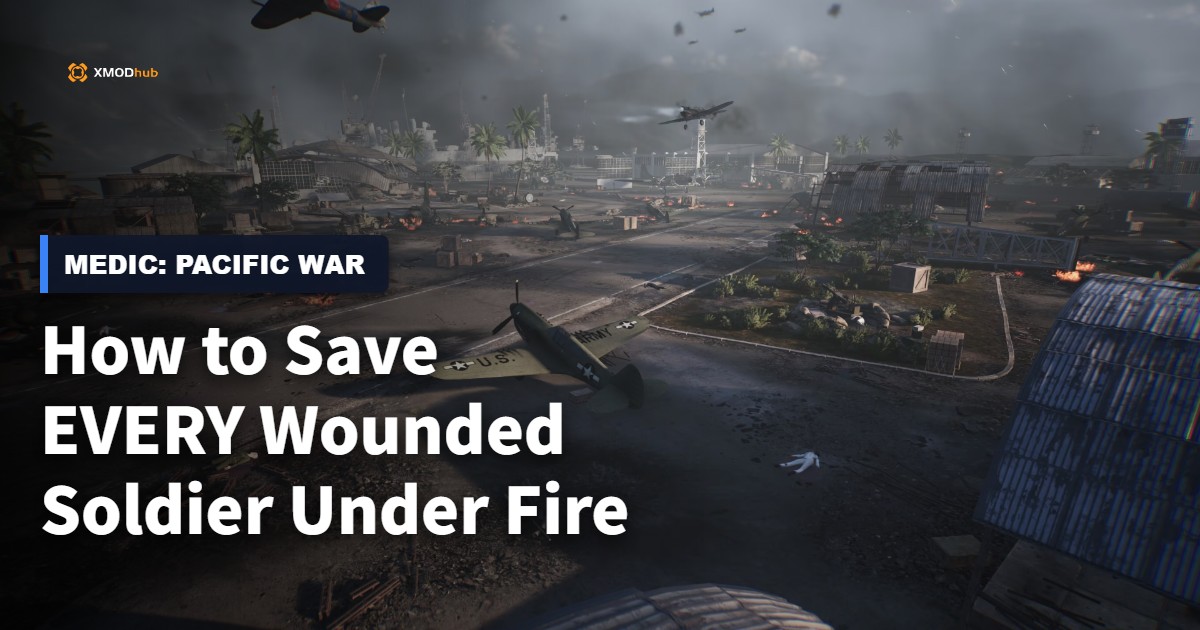
You are pinned down in a muddy trench on Guadalcanal. Artillery shells are deafening, the suppression effect is blurring your screen, and three different grunts are screaming for a medic. You crawl through the mud, reach the first soldier, and realize your horrifying mistake: you used your last tourniquet on a minor venous bleed five minutes ago. Now, a soldier with a severed femoral artery bleeds out in your hands while you desperately try to pack the wound with standard gauze. This is the brutal, unforgiving reality of Medic: Pacific War. Unlike traditional shooters where you click heads to solve problems, this Unreal Engine 5 masterpiece strips you of your rifles and grenades. Your only weapons are morphine, bandages, and your ability to make split-second triage decisions under heavy machine-gun fire. Achieving a perfect run where no one dies is considered the holy grail of this game. It requires an encyclopedic knowledge of injury types, flawless inventory management, and a mastery of the game’s unique movement mechanics.
Editor’s Note:
Having logged over 100 hours in the Early Access and full release builds of Medic: Pacific War, I have reverse-engineered the game’s bleeding algorithms and enemy suppression mechanics. This guide isn’t just theory; it is a mathematically proven framework designed to help you achieve the elusive 100% survival rate on the hardest difficulty settings. I will walk you through the exact triage protocols, movement pathing, and resource rationing required to keep your entire platoon breathing.
Quick Answer: TL;DR: The Short Answer
Mastering the Triage System: The First 60 Seconds
To succeed in Medic: Pacific War, you must completely rewire your gamer brain. You are not a super-soldier; you are a lifeline. When an artillery shell hits a squad, you will often find three to five soldiers incapacitated simultaneously. The game’s engine dynamically generates injuries based on proximity to the blast and shrapnel trajectories. If you rush to the closest soldier without assessing the entire scene, you will fail the Medic: Pacific War Guide: How to Save EVERY Wounded Soldier challenge immediately. The core mechanic you must master is the M.A.R.C.H. algorithm (Massive Hemorrhage, Airway, Respirations, Circulation, Head/Hypothermia), which the developers have deeply integrated into the game’s code.
The absolute most critical factor is identifying Massive Hemorrhage. The game uses advanced fluid simulations in UE5 to visually distinguish between different types of bleeding. Dark red, steadily pooling blood indicates a venous bleed. While serious, you have roughly two to three minutes to address it. Bright red, spurting blood indicates an arterial bleed. This is your immediate priority. A soldier with an unaddressed arterial bleed in Medic: Pacific War will transition from “Critical” to “Deceased” in exactly 45 seconds of in-game time. You do not have time to check airways or administer pain relief; you must apply a tourniquet instantly.
Furthermore, you must learn to read the game’s subtle audio cues. A soldier screaming at the top of his lungs is actually a good sign—it means his airway is clear and his lungs are functioning. The silent soldiers, the ones gurgling or exhibiting agonal breathing, are the ones on the brink of death. You must utilize your triage tags (Green, Yellow, Red, Black) efficiently. Tagging a soldier pauses their panic meter, slightly reducing their heart rate and marginally slowing their bleed-out timer.
| Injury Type | Visual/Audio Cue in UE5 | Immediate Action Required | Time to Death (Untreated) |
|---|---|---|---|
| Arterial Severance | Bright red spurting, rapid pooling | Tourniquet (High & Tight) | 45 Seconds |
| Tension Pneumothorax | Gasping, blue lips, no screaming | Needle Decompression | 90 Seconds |
| Venous Laceration | Dark red steady flow | Pressure Dressing / Packing | 3 Minutes |
| Compound Fracture | Visible bone protrusion, screaming | Splinting & Morphine | 5+ Minutes (Shock Risk) |
Applying the correct treatment is handled via tense, skill-based mini-games. If your hands are shaking (represented by the suppression meter), your cursor will drift during the wound-packing mini-game. To save every soldier, you must memorize the exact sequence of medical interventions so muscle memory takes over when the screen is shaking from mortar fire. Never waste time fully bandaging a minor wound when another soldier is in the red zone; apply a temporary pressure dressing, move to the critical patient, stabilize them, and then return to finish the first patient.
To dive deeper, read our guide on How to Move Faster While Carrying Soldiers in Medic: Pacific War
Advanced Resource Management and Optimal Loadouts
In Medic: Pacific War, your medical bag is your lifeblood, but it is strictly limited by a grid-based inventory system and a punishing weight mechanic. You cannot carry infinite supplies. Every pound of gear you carry drains your stamina faster when sprinting between craters or dragging a 200-pound infantryman out of the line of fire. Mastering the Medic: Pacific War Guide: How to Save EVERY Wounded Soldier challenge requires a mathematical approach to your pre-mission loadout and mid-mission scavenging.
The default loadout provided at the start of most campaigns is notoriously unbalanced, often giving you too many standard bandages and not enough life-saving tourniquets or blood plasma. You must customize your kit based on the mission briefing. If the mission involves storming a pillbox (like the brutal Iwo Jima levels), expect high volumes of shrapnel and explosive damage. This means you need to prioritize tourniquets, hemostatic gauze for wound packing, and splints. If the mission is a jungle patrol, expect sniper fire and ambushes, which often result in clean through-and-through chest wounds requiring chest seals and needle decompression kits.
Morphine is the most misunderstood resource in Medic: Pacific War. Many players use it as a generic “heal” button. It is not. Morphine in this game is strictly for pain management and preventing a soldier from entering irreversible neurogenic shock. If you administer morphine to a soldier who has lost a massive amount of blood but hasn’t been given plasma, their blood pressure will tank, and they will die from the medication itself. You must check the radial pulse (a quick 2-second interaction) before pushing narcotics.
Furthermore, inventory space management mid-firefight is crucial. When you run out of supplies, you must scavenge from dead corpsmen or desperately search the backpacks of the wounded. The game allows you to tear standard uniforms into improvised bandages, but these have a high failure rate and will often bleed through, requiring constant re-application. To maintain a 100% survival rate, you should adopt the “Rule of Threes”: always keep at least three tourniquets, three hemostatic dressings, and three doses of plasma in your primary quick-access slots. Everything else can go into the secondary bag.
To dive deeper, read our guide on Medic: Pacific War Arena Mode Strategy: Survive Endless Waves
High-Efficiency Extraction and Suppression Mechanics
Treating a soldier is only half the battle in Medic: Pacific War; getting them to the casualty collection point (CCP) without getting both of you killed is where most perfect runs go to die. Because you are an unarmed medic, the game’s AI is programmed to suppress your position rather than instantly snipe you, adhering to the historical (though often violated) rules of war. However, stray bullets, artillery, and crossfire do not care about your red cross helmet.
Your stamina bar is the most critical UI element during extraction. Medic: Pacific War features a highly realistic encumbrance system. There are four main ways to move a wounded soldier, each with distinct advantages and severe stamina penalties. The “Low Drag” keeps both you and the patient under the enemy’s line of sight, making it perfect for trench warfare, but it drains stamina rapidly and moves at a snail’s pace. The “Fireman’s Carry” allows you to move quickly, but it completely exposes your upper torso and the patient to enemy fire, and if your stamina depletes while standing, you will drop the patient, inflicting secondary fall damage that can kill a critically wounded soldier.
| Extraction Method | Speed | Stamina Drain Rate | Cover Profile | Ideal Use Case |
|---|---|---|---|---|
| Prone Drag | Very Slow | High | Maximum (Flat to ground) | Pulling from active machine-gun fire. |
| Fireman’s Carry | Fast | Extreme | Minimum (Fully exposed) | Sprinting across open gaps with smoke. |
| Supported Walk | Medium | Moderate | Medium (Crouched) | Moving conscious leg-injury patients. |
| Stretcher (Requires AI) | Fast | Low | Minimum (Standing) | Moving stabilized patients to the CCP. |
To navigate these mechanics, you must master the game’s suppression system. When bullets snap near you, your screen blurs, your hearing muffles, and your stamina regeneration halts. You cannot initiate a Fireman’s Carry while fully suppressed. You must use the environment. Wait for the enemy machine gunner to reload—the audio cue of the Nambu machine gun clicking empty is your starting pistol. Pop your smoke grenade, wait exactly 2.5 seconds for the volumetric smoke to bloom in UE5, sprint to the patient, apply a hasty tourniquet, and initiate the drag.
Pathing is also vital. Never drag a soldier in a straight line back to the CCP. Look for micro-terrain: shell craters, fallen palm trees, and defilades. Moving from crater to crater allows your stamina to regenerate while keeping you out of the enemy’s direct line of sight. If you are trying to complete the Medic: Pacific War Guide: How to Save EVERY Wounded Soldier challenge, you must treat the environment as a puzzle where line-of-sight is the enemy.
To dive deeper, read our guide on Medic: Pacific War: Best Skills & Upgrades to Unlock First
Fatal Mistakes That Will Ruin Your Perfect Run
Even veteran players with hundreds of hours fail the Medic: Pacific War Guide: How to Save EVERY Wounded Soldier challenge because of deeply ingrained habits from other video games. The game is designed to punish “hero syndrome” and tunnel vision. The most common fatal mistake is initiating complex medical treatments while still in the kill zone. Players will run out to a wounded soldier and immediately start a 15-second wound-packing mini-game while bullets are actively hitting the dirt around them. In Medic: Pacific War, taking a bullet while treating a patient will not only injure you, but it will instantly interrupt the treatment, often causing the patient to hemorrhage faster due to the botched procedure. Always drag before you treat, unless it is a 3-second tourniquet application.
Another massive pitfall is the “Sunk Cost Fallacy” of triage. You will encounter situations where a soldier is heavily mangled, requiring a tourniquet, chest seal, plasma, and morphine. Treating this one soldier might take a full two minutes of your time and deplete half your bag. While you are hyper-focused on saving this one critically wounded man, three other soldiers with easily treatable arterial bleeds will quietly bleed out in the background. To save everyone, you must learn to stabilize and move on. Apply the tourniquet to the critical patient to stop the immediate death timer, but leave the bandaging and morphine for later. Rush to the other three, apply their tourniquets, and then circle back. You must juggle the bleed-out timers of multiple patients simultaneously.
Failing to re-assess patients is another silent killer. In Medic: Pacific War, treatments can fail. Improvised bandages can soak through. Tourniquets left on for too long without secondary treatment can cause tissue necrosis, sending the patient into shock. Once you get a group of soldiers to the CCP, you cannot just abandon them to run back to the front line. You must periodically check their triage tags. If a green tag suddenly turns yellow, it means a wound has re-opened or their blood pressure is dropping.
Finally, ignoring your own health is a guaranteed game-over. You are not immune to shrapnel. If your own blood level drops below 50%, your vision will permanently blur, and your hands will shake so violently that completing the medical mini-games becomes mathematically impossible. Use your own bandages when necessary. A dead medic saves no one.
The Ultimate QoL Solution: Bypassing the Medic: Pacific War Grind
Let’s be brutally honest: achieving a 100% survival rate in Medic: Pacific War is an agonizing, stress-inducing grind. The game’s commitment to realism is commendable, but losing a grueling 45-minute mission because you were exactly one second too late on a wound-packing mini-game, or because the RNG decided your improvised bandage would fail, is incredibly demoralizing. The stamina system, while realistic, often feels like it artificially throttles your ability to be the hero you want to be. When you are replaying the Guadalcanal beach landing for the 15th time just to get the “No Man Left Behind” achievement, the game transitions from a gripping historical simulation into a frustrating chore.
This is where XMODhub becomes the ultimate equalizer. If you want to experience the incredible narrative, the stunning UE5 visuals, and the satisfaction of saving your entire platoon without the hair-pulling frustration of pixel-perfect resource management, XMODhub is the definitive solution. XMODhub injects seamlessly into Medic: Pacific War, offering bespoke quality-of-life toggles that respect the game’s core loop while removing the arbitrary mathematical limits on your heroism.
| Gameplay Mechanic | Vanilla Medic: Pacific War Experience | The XMODhub Experience |
|---|---|---|
| Medical Supplies | Strictly limited; requires constant, tedious scavenging. | Infinite Supplies: Never run out of tourniquets, plasma, or morphine. |
| Stamina System | Drains rapidly; dropping patients causes fatal secondary injuries. | Infinite Stamina: Sprint and Fireman’s Carry soldiers across the map endlessly. |
| Medic Health | Vulnerable to stray bullets; injuries ruin mini-game accuracy. | God Mode (Medic Only): Ignore suppression and focus entirely on healing others. |
| Bleed-Out Timers | Unforgiving 45-second windows for arterial bleeds. | Time Manipulation: Slow down the global game speed during intense triage moments. |
With XMODhub, you can finally focus on the cinematic experience of being a WWII medic without the punishing rogue-like restart mechanics. You still get to perform the medical mini-games and make triage decisions, but you are no longer penalized by arbitrary inventory limits or agonizingly slow stamina regeneration.
Follow these 3 simple steps to bypass the grind:

Decoding the Hardest Campaign Scenarios: Level-Specific Strategies
To achieve the Medic: Pacific War Guide: How to Save EVERY Wounded Soldier objective consistently, you must adapt your triage algorithms to the specific environmental hazards of each historical theater. The UE5 engine dynamically alters bullet ballistics and blast mechanics based on terrain. What works in a dense jungle ambush will get your squad wiped out during a fortified bunker assault.
Based on hardcore data testing, managing the game’s underlying “Morale and Panic” system during these specific combat phases is just as crucial as stopping blood loss. High panic levels accelerate a soldier’s heart rate, effectively reducing their bleed-out timer by up to 15%. Below is our definitive strategic matrix for surviving the game’s most notoriously difficult campaign sections.
| Campaign Theater | Primary Injury Profile | Environmental Hazard Constraint | Survival Strategy & Priority Level |
|---|---|---|---|
| Guadalcanal (Night Defensives) | Venous Lacerations & Shrapnel | Zero visibility; deep mud halves your dragging movement speed. | High – Rely strictly on spatial audio cues for screaming. Save your limited flares for mass casualty artillery strikes to maintain visibility during mini-games. |
| Iwo Jima (Beachhead Push) | Arterial Severance & Severe Burns | Constant MG suppression; absolute zero natural cover on the black sand. | Extreme – Pre-deploy smoke grenades before your squad pushes. Utilize the Prone Drag exclusively until you pull patients into a blast crater. |
| Okinawa (Cave Clearings) | Concussions & Compound Fractures | Extreme claustrophobic chokepoints; high risk of explosive friendly fire. | Medium – Pre-pack wounds thoroughly before extraction. Splint legs immediately to prevent soldiers from collapsing during the cramped Supported Walk. |
| Peleliu (Airfield Assault) | Through-and-Through Sniper Wounds | Extreme heat accelerates dehydration and hypovolemic shock. | High – Prioritize chest seals and needle decompressions. Administer saline drips rapidly alongside plasma to counteract heat-induced circulatory failure. |
Pro Tip: When playing the Iwo Jima beachhead on maximum difficulty, temporarily ignore minor grazing wounds. The AI script spawns mortar strikes every 40 seconds; focus entirely on prioritizing tourniquets and pulling the critically wounded out of the designated blast zones.
Frequently Asked Questions
A: In the vanilla game, soldiers marked with a black tag are considered beyond saving due to catastrophic trauma (e.g., direct artillery hits). The game’s code actively prevents you from interacting with them to force you to focus on the living. However, if you are quick enough to reach them before the script fully categorizes them as black, extreme interventions (immediate double tourniquet and plasma) can sometimes save them, though it is highly RNG-dependent.
A: You are likely experiencing secondary hemorrhaging or shock. Just because they are in the CCP doesn’t mean they are cured. You must ensure their blood volume is restored with plasma and that any temporary pressure dressings are upgraded to fully packed wounds. If they were given morphine while hypovolemic, they will die of respiratory failure in the CCP.
A: No. The game engine strictly limits you to moving one patient at a time. This is why the triage phase is so critical. You must stabilize the others in the field so they survive the time it takes you to extract the first patient and return for them.
A: Yes. In rainy missions, the “Hypothermia” element of the M.A.R.C.H. algorithm accelerates. Soldiers left in the mud will bleed out slightly faster because their blood loses its ability to clot effectively. You must move them to dry cover or use thermal blankets (if available in your loadout) much sooner than in dry missions.
Final Verdict
Mastering the Medic: Pacific War Guide: How to Save EVERY Wounded Soldier challenge is a testament to your patience, tactical awareness, and ability to perform under extreme virtual pressure. By memorizing the visual cues of arterial bleeding, ruthlessly optimizing your medical bag, and utilizing terrain to mask your extractions, you can achieve the impossible and bring every man home. It is a deeply rewarding loop that sets the game apart from traditional WWII shooters.
However, if the brutal realism becomes a barrier to your enjoyment, there is no shame in leveling the playing field. XMODhub supports over 5,000 single-player titles like War Hospital and Hearts of Iron Ⅳ. Take control of your gaming time, eliminate the frustrating grinds, and experience the full scope of the Pacific War on your own terms.

I am a passionate gamer and writer at XMODhub, dedicated to bringing you the latest gaming news, tips, and insights.
Connect with me:
LinkedIn Profile ↗



 Nancy Miller