
 Catherine Hu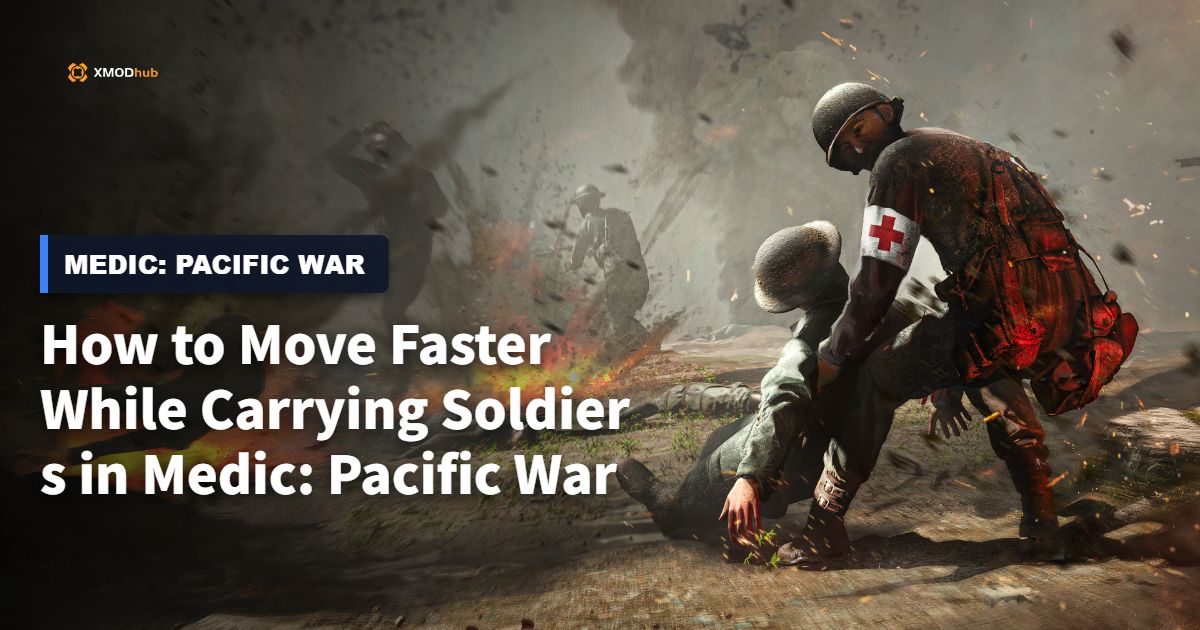
Picture this: You are pinned down on the black sands of Iwo Jima. Artillery shells are deafening, and a rifleman ten yards away is screaming for a medic. You pop a smoke grenade, sprint through the chaos, and successfully patch his arterial bleed. But the moment you hoist him onto your shoulders to extract him to the triage tent, your character turns into a sluggish, encumbered snail. Your stamina bar plummets to zero in seconds, you are forced into a painfully slow walking animation, and a Japanese machine-gunner effortlessly mows both of you down. If you have experienced this exact, controller-smashing scenario, you are not alone.
Figuring out How to Move Faster While Carrying Soldiers in Medic: Pacific War is arguably the most critical survival skill in this grueling World War II simulator. Because you play as an unarmed medic, your only defense is your mobility. When you add 180 pounds of dead weight to your character, the Unreal Engine 5 physics completely alter your movement capabilities. This guide will completely deconstruct the encumbrance and stamina mechanics, showing you exactly how to optimize your extraction routes, manage your stamina economy, and ensure you never become a sitting duck on the battlefield again.
Editor’s Note:
“During my first 40 hours in the Early Access build of Medic: Pacific War, I lost 60% of my patients not to failed medical minigames, but because I couldn’t get them to cover fast enough. Once you understand the hidden terrain modifiers and the stamina-drain curve, casualty extraction goes from a suicide mission to a calculated, high-speed tactical maneuver.”
Quick Answer: TL;DR: The Short Answer
Mechanics Deep Dive: Understanding the Problem
To truly understand How to Move Faster While Carrying Soldiers in Medic: Pacific War, we have to look under the hood of the game’s brutal survival mechanics. Unlike arcade shooters where carrying an objective barely affects your speed, Medic: Pacific War uses a highly realistic weight distribution and stamina depletion system. When players complain about moving too slowly, they are usually falling victim to three specific, overlapping mechanics that the game does not explicitly explain in its tutorial.
The Brutal Reality of the Encumbrance System
In Medic: Pacific War, your base movement speed is dictated by your current encumbrance. As an unarmed medic, your base weight consists of your medical supplies (morphine, bandages, plasma). However, the moment you interact with a wounded soldier, their body weight—and their equipment weight—is instantly added to your character’s load. This immediately triggers a 60% reduction in your base movement speed. Furthermore, the game features a “Suppression” mechanic. When bullets fly close to your character, your screen blurs, and your movement speed is penalized by an additional 15%. If you are carrying a soldier while suppressed, you are essentially moving at 25% of your normal speed.
Mistake 1: Sprinting Before the Lift (The Stamina Trap) The most common mistake players make when trying to figure out How to Move Faster While Carrying Soldiers in Medic: Pacific War is mismanaging their stamina before the extraction even begins. When you hear a soldier call for a medic, your instinct is to click the sprint button and dash toward them. However, if you arrive at the casualty with only 20% of your stamina remaining, you are setting yourself up for failure. Hoisting a soldier onto your shoulders costs a flat 15% stamina, and moving while carrying them drains stamina at a rate of 10% per second. If you start the carry with no stamina, your character instantly enters the “Exhausted” state. In this state, you cannot jog, and your walking speed is reduced to a crawl. To fix this, you must jog (not sprint) to the casualty, or wait behind cover for 3-4 seconds to let your stamina regenerate to at least 85% before initiating the lift animation.
Mistake 2: Ignoring UE5 Terrain Deformation Modifiers Because Medic: Pacific War was developed on Unreal Engine 5, it utilizes advanced terrain deformation and physics. The ground you walk on drastically impacts your movement speed, especially when heavily encumbered. Players often try to take the shortest linear path back to the triage tent. Unfortunately, in the Pacific theater, the shortest path usually involves running through deep mud craters, flooded rice paddies, or loose volcanic sand. Carrying a soldier through deep mud applies a hidden 40% movement speed penalty on top of your encumbrance penalty. If you want to move faster, you must actively scan the environment for solid ground. Running on wooden duckboards, hard-packed dirt roads, or rocky outcrops will completely negate the terrain penalty, allowing you to extract the soldier significantly faster, even if the route is a few meters longer.
Mistake 3: Misusing the Carry vs. Drag Animations Medic: Pacific War offers two distinct ways to move a casualty: the Fireman’s Carry and the Low-Profile Drag. A massive error players make is stubbornly using the Fireman’s Carry in every situation. The Fireman’s Carry allows for a faster top speed, but it drains stamina incredibly fast and drastically increases your physical hitbox, making you a magnet for enemy sniper fire (which triggers the Suppression slow-down effect). On the other hand, the Low-Profile Drag has a slower top speed, but it drains almost zero stamina and keeps you low to the ground, preventing the Suppression penalty. If you are under heavy fire, dragging the soldier will actually result in a faster overall extraction because you won’t be slowed down by bullet suppression or stamina exhaustion. Knowing when to seamlessly switch between these two stances is the hallmark of a veteran player.
Best Alternative Methods and Advanced Tips
If you want to ensure zero casualties and master the deeper mechanics of the game, you need to read our ultimate triage and casualty extraction walkthrough. However, if you are specifically looking for high-level strategies to optimize your movement speed during extractions, here are the best alternative methods used by hardcore players to bypass the game’s intentional sluggishness.
The Ultimate QoL Solution: Bypassing the Grind with XMODhub
Let’s be brutally honest: while mastering the stamina economy and terrain modifiers in Medic: Pacific War is rewarding for some, it can be incredibly tedious for others. If you just want to experience the immersive triage gameplay and save lives without feeling like you are walking through wet cement every five minutes, the mechanics can feel overly punishing. When you are tired of failing extractions because of a depleted stamina bar, it is time to use XMODhub.
XMODhub provides a safe, undetectable, and highly customizable trainer specifically tailored for the pain points of Medic: Pacific War. Instead of memorizing terrain modifiers, you can instantly optimize your gameplay.
Recommended XMODhub Features for Medic: Pacific War:
Follow these 3 simple steps to fix this instantly:

Advanced Encumbrance Breakdown: Casualty Weight and Skill Upgrades
To truly min-max your extraction routes in Medic: Pacific War, you have to realize that not all casualties are created equal. The game calculates the total weight on your shoulders dynamically based on the specific loadout and class of the soldier you are rescuing. Identifying target weight classes before you sprint out of cover will fundamentally change how you approach extractions.
The Casualty Weight Matrix (Who You Carry Matters)
If you try to Fireman’s Carry a Heavy Gunner with a full ammo belt the same way you carry a lightly armored scout, you will find your stamina draining almost twice as fast. Below is the hidden data framework that dictates your base movement speed penalties depending on the casualty type:
| Casualty Loadout Class | Base Speed Penalty | Stamina Drain Rate | Optimal Extraction Method |
|---|---|---|---|
| Standard Rifleman | 60% Penalty | Base Rate (10%/sec) | Fireman’s Carry (Short Distance) |
| Heavy Gunner (M1918 BAR) | 85% Penalty | Severe (18%/sec) | Low-Profile Drag (Mandatory) |
| Radio Operator | 70% Penalty | High (14%/sec) | Staggered Drop Technique |
| Officer / Scout Medic | 55% Penalty | Light (8%/sec) | Fireman’s Carry (Sprint capable) |
Prioritizing Mobility in the Combat Lifesaver Skill Tree As you level up, bypassing these massive weight penalties relies on selecting the correct passive nodes in the “Physical Conditioning” skill tree branch. While many players mistakenly rush for medical capacity upgrades, a dead medic saves no one. You should prioritize the “Pack Mule T1” and “Adrenaline Surge” nodes first. The Pack Mule perk mitigates the weight penalty of standard riflemen by a flat 15%, which crosses a hidden threshold in the game engine, allowing you to transition from the “Exhausted Walk” animation into a standard light jog while encumbered.
Frequently Asked Questions
A: Yes, it absolutely does. As detailed in our matrix above, the game calculates the total encumbrance based on the soldier’s class. A Heavy Gunner carrying a BAR will slow you down significantly more than a standard Rifleman. If you have a few seconds to spare, you can interact with the casualty’s dropped primary weapon and kick it away or strip their heavy ammo pouches before lifting them, which slightly reduces the weight penalty and increases your carry speed.
A: In the current Early Access build of Medic: Pacific War, stretchers require two people to operate. You can call an AI medic assistant to help you carry a stretcher. While this completely removes the stamina drain on your character and moves faster than a solo drag, coordinating the AI under heavy fire can be clunky. For solo extractions, you are limited to the shoulder carry or the drag.
A: Yes. If you are shot in the leg or arm while carrying a soldier, your character suffers a physical trauma debuff. A leg wound will permanently cap your maximum movement speed at 50% until you stop and bandage yourself. Always prioritize your own health; a dead medic cannot save anyone.
A: Medic: Pacific War features a “Combat Lifesaver” progression tree. As you successfully save soldiers and complete missions, you earn experience points. You can invest these points into the “Physical Conditioning” branch, which offers passive perks like a 20% increase to maximum stamina and a 10% reduction in the encumbrance weight penalty. Unlocking these should be your first priority.
Final Verdict
Mastering How to Move Faster While Carrying Soldiers in Medic: Pacific War is a delicate dance of stamina management, terrain awareness, and tactical positioning. By avoiding the trap of sprinting into the danger zone, utilizing the staggered drop technique, and making smart use of your squad’s suppressive fire, you can drastically reduce your extraction times and keep your patients alive. The game demands patience and realism, punishing those who try to play it like a fast-paced arcade shooter.
However, if the hyper-realistic encumbrance system is ruining your enjoyment of an otherwise brilliant WWII medical simulator, you don’t have to suffer through it. With XMODhub, you can instantly tweak the game’s physics to your liking. XMODhub supports over 5,000 PC titles, including War Hospital and Hearts of Iron Ⅳ. Take control of your gaming experience today and ensure every soldier makes it home.

I am a passionate gamer and writer at XMODhub, dedicated to bringing you the latest gaming news, tips, and insights.
Connect with me:
LinkedIn Profile ↗


 Nancy Miller