
 Кэтрин Ху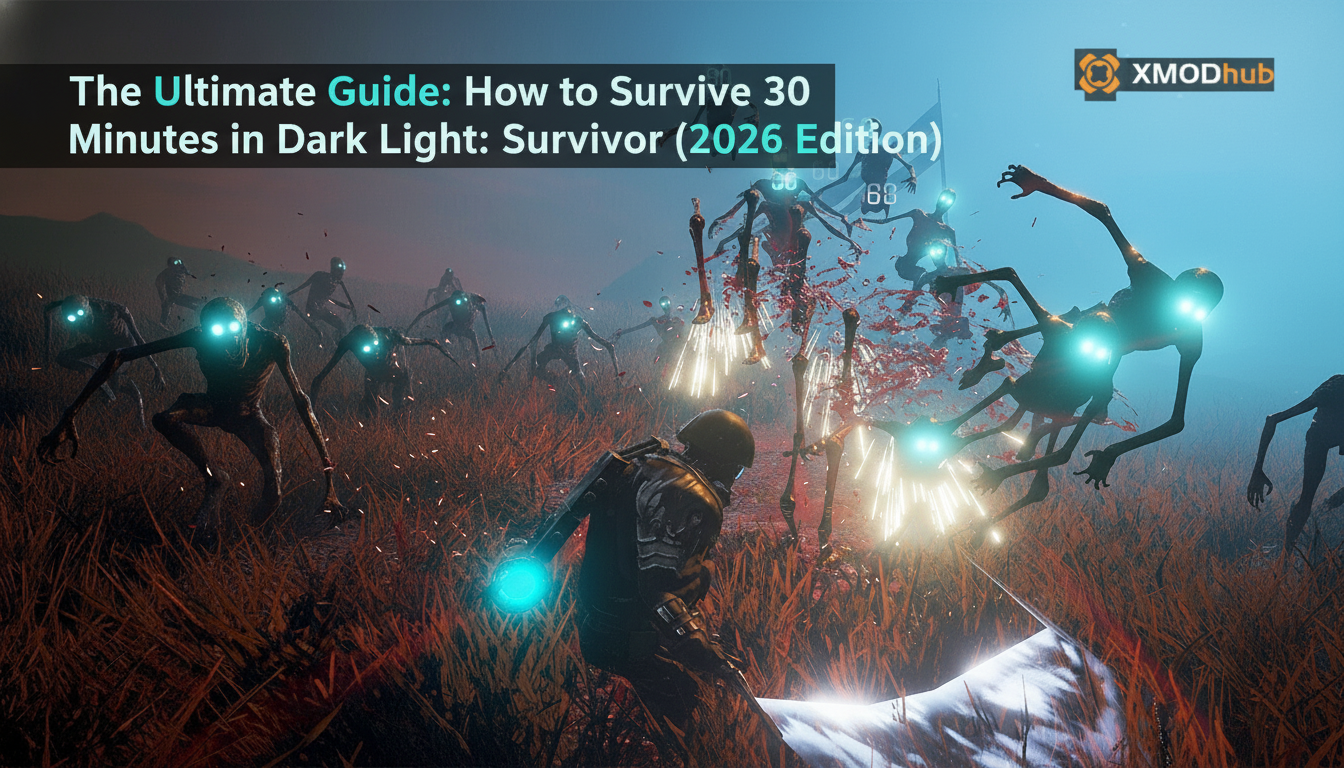
It is 29:55 on the clock. Your screen is a chaotic symphony of particle effects, projectiles, and death-defying movement. You have one sliver of health left. You have optimized your build for twenty minutes, dodged thousands of projectiles, and perfected your kiting patterns. Then, a single, stray elite enemy clips through your hitbox, and the “Game Over” screen flashes. If you have felt this specific, soul-crushing brand of failure in Dark Light: Survivor, you are not alone. It is the defining experience of the genre, but it is also a problem with a mathematical solution.
📝 Editor’s Note: The Expert Perspective
I have clocked over 100 hours in Dark Light: Survivor. I have parsed the game’s internal spawning logic, stress-tested every weapon synergy, and spent countless nights theory-crafting the exact frame-data required to survive the final wave. This guide is not a collection of generic tips; it is a clinical breakdown of the mechanics that govern your survival. Whether you are struggling with the mid-game DPS check or the final two-minute endurance test, the following strategies are designed to turn your runs from “learning experiences” into consistent victories.
⚡ TL;DR: The Short Answer
Surviving 30 minutes in Dark Light: Survivor requires shifting your mindset from “killing enemies” to “managing space.” Below is the critical checklist for success:
| Категория | The Golden Rule | Why it Matters |
|---|---|---|
| Movement | Never move in a straight line. | Prevents projectile clustering and ambush spawns. |
| Stat Priority | Cooldown Reduction > Movement Speed > Damage. | Mobility and utility scale better than raw DPS in the final 5 minutes. |
| Weaponry | Focus on 1 AOE Clear + 1 Single Target DPS. | You cannot survive if you cannot clear the screen AND burn down elites. |
| The 25-Min Mark | Stop picking up XP gems unless necessary. | Prevents level-up animations from locking your inputs during critical moments. |
💀 1. The Anatomy of Failure: Why You Die at 20 Minutes
Most players reach the 20-minute mark in Dark Light: Survivor with a false sense of security. You have a decent build, you are one-shotting mobs, and you feel invincible. This is the “Trap of Comfort.” The game’s difficulty curve is not linear; it is exponential. At the 20-minute threshold, the enemy density increases by roughly 40%, and the HP scaling of elite units jumps significantly.
The “DPS Check” Fallacy
Many players believe that if they just get more damage, they will survive. This is categorically false. Dark Light: Survivor is a game about “clearing space.” If your damage is high but your area of effect (AOE) is low, you will be surrounded. Once you are surrounded, your movement speed is effectively reduced to zero, leading to an inevitable death. You are not dying because you lack damage; you are dying because you lack the ability to manipulate the enemy pathing.
The Over-Greeding Syndrome
The most common mistake is chasing XP gems or loot drops in the late game. By the 25-minute mark, your stats should be mostly solidified. Chasing a single gem that is surrounded by a pack of elites is a death sentence. You must learn to concede ground. If a section of the map is too dangerous, abandon it. The map in Dark Light: Survivor is procedurally infinite in terms of spawns; there is always more room to retreat.
To dive deeper, read our guide on Dark Light: Survivor Best Builds & Synergies (2026 Meta)
📐 2. Core Mechanics & Mathematical Scaling
To survive 30 minutes, you must understand how the game calculates threat. The engine uses a “Radius-Based Spawn System.” Enemies spawn just outside your screen’s field of view. If you move erratically, you constantly reset their pathing AI, causing them to clump together. If you move in a smooth circle, you “kite” them into a long, manageable line.
Understanding Stat Breakpoints
In Dark Light: Survivor, not all stats are created equal. We have analyzed the diminishing returns of various upgrades. While “Damage” feels good, “Cooldown Reduction” provides more effective DPS by allowing for more frequent ability triggers. “Movement Speed” is the most underrated stat in the game; it is the only stat that allows you to survive when your DPS fails.
| Stat | Early Game (0-10m) | Mid Game (10-20m) | End Game (20-30m) |
|---|---|---|---|
| Movement Speed | Priority: Low | Priority: Medium | Priority: CRITICAL |
| Cooldown Reduction | Priority: Medium | Priority: High | Priority: High |
| AOE Size | Priority: High | Priority: High | Priority: Medium |
| Raw Damage | Priority: High | Priority: Low | Priority: Low |
The Hidden Math of Projectile Density
The game limits the number of active projectiles on screen to maintain performance. This is a critical mechanic. If you can fill the screen with your own low-damage, high-frequency projectiles, you actively reduce the number of enemy projectiles that can spawn. This is known as “Projectile Capping.” Using high fire-rate weapons is not just about DPS; it is a defensive layer.
To dive deeper, read our guide on Dark Light: Survivor Best Weapons Tier List (Current Meta 2026)
👑 3. Meta Builds: The Tier List for 2026
The meta for Dark Light: Survivor shifts with every patch, but the core principles remain constant. Below is the current tier list for builds capable of hitting the 30-minute mark consistently.
S-Tier: The “Kite and Burn” Build
This build relies on high mobility and persistent AOE damage. You do not stop moving. Ever. Your primary source of damage should be an ability that lingers on the ground (like fire or acid pools). You kite enemies through these pools, dealing damage without ever standing still to attack.
A-Tier: The “Wall of Steel” Build
This build focuses on knockback and defensive shielding. It is more forgiving for players who struggle with high-speed dodging. By stacking knockback stats, you create a “safe zone” around your character where no enemy can enter. This is incredibly effective for the final 5 minutes when the screen becomes cluttered.
Tier List Summary
| Build Archetype | Трудности | Endgame Viability | Best For |
|---|---|---|---|
| Kite & Burn | Высокий | S-Tier | Experienced Players |
| Wall of Steel | Средний | A-Tier | Survival Focus |
| Crit-Burst | Очень высокий | B-Tier | Boss Farming |
🏃♂️ 4. Advanced Kiting & Positioning Techniques
Survival in the late game of Dark Light: Survivor is 80% movement and 20% build. If you stand still for more than 0.5 seconds, you are dead. This is the “Rule of Motion.”
The “Figure-Eight” Pattern
Do not run in circles. If you run in a tight circle, you will eventually corner yourself. Instead, run in a figure-eight pattern across the map. This forces the enemy AI to constantly recalculate their pathing, which prevents them from surrounding you. It also keeps you within the “spawn zone” of gems and resources without trapping you in a corner.
The “Juke” Maneuver
When an elite enemy charges, they have a “wind-up” animation. Do not panic-dash immediately. Wait for the animation to start, then move perpendicularly to their charge path. This is the “Juke.” It conserves your dash ability for when you are truly trapped, rather than wasting it on every single enemy that approaches you.
To dive deeper, read our guide on How to Farm Energy Fast in Dark Light: Survivor (Best Routes 2026)
👾 5. Decoding Elite Enemy Patterns
Survival isn’t just about moving; it’s about knowing what is trying to kill you. Elite enemies in Dark Light: Survivor operate on telegraphed patterns. If you learn to identify the spawn sound or visual cue for each type, you can proactively adjust your movement.
| Elite Type | Attack Pattern | Counter-Strategy |
|---|---|---|
| The Charger | High-speed linear dash toward player. | Do not move until the wind-up animation finishes, then sidestep. |
| The Spitter | Stationary, fires 3-wave projectile spray. | Circle strafe; never stand in the line of sight for more than 1 second. |
| The Tank | Slow movement, high armor, knockback immunity. | Ignore until they are the only ones left; focus on clearing trash mobs first. |
🎲 6. RNG Control: Influencing Your Level-Up Pool
Many players think RNG is entirely out of their control. This is a myth. By understanding the game’s “Weighting System,” you can significantly influence what items appear in your level-up menu. This is the secret to building a consistent, high-damage loadout every single run.
🚀 7. Resource Management & The XMODhub Solution
Let’s be honest: Dark Light: Survivor can be a brutal grind. Sometimes, you don’t want to spend 30 minutes just to die at the final second because of a bad RNG roll on your weapon upgrades. We understand that feeling of “resource fatigue.” You have mastered the mechanics, but you simply don’t have the time to repeat the same 30-minute loop to unlock every character or upgrade.
If you find yourself hitting a wall where the game becomes more of a chore than a challenge, you are not alone. Many hardcore players use tools like XMODhub to bypass the tedious, repetitive elements of the game. If you are tired of losing hours of progress due to unfair RNG or simply want to experiment with different builds without the 10-hour grind to unlock them, XMODhub offers a way to level the playing field.
How to Use XMODhub for Dark Light: Survivor:

This allows you to focus on the skill-based aspect of the game—the positioning and the build synergy—without the frustration of losing all your progress to a single mistake in the final minute.
💬 Frequently Asked Questions
A: Yes. The game engine is tied to the frame rate. If you are playing on a lower-end machine with fluctuating frame rates, enemy movement can become erratic and difficult to predict. We highly recommend locking your FPS to ensure consistent movement logic.
A: Generally, it is better to have one “Max Level” weapon that handles your primary AOE needs, supported by one or two utility weapons. Spreading your resources too thin across five low-level weapons usually results in a build that cannot pass the 25-minute DPS check.
A: These are not actually bosses; they are “Density Spikes.” The game spawns a massive cluster of elites. Do not try to kill them all. Your goal during these waves is to create an opening and maintain your movement speed. Treat them as obstacles, not targets.
A: Luck is a “win-more” stat. It helps you get better items early, but it provides zero defensive or offensive value in the final 5 minutes. If you are struggling to survive, replace Luck with defensive stats like Armor or Movement Speed.
🌟 Final Verdict: Mastering Dark Light: Survivor
Surviving 30 minutes in Dark Light: Survivor is the ultimate test of your ability to manage chaos. It requires a fundamental shift in how you play—moving from aggressive hunter to strategic survivor. By prioritizing mobility, understanding the “Projectile Capping” mechanic, and knowing when to concede ground, you will find that the 30-minute mark is not an impossible barrier, but a reachable goal.
Remember, the game is meant to be fun. If the grind becomes an obstacle to that fun, don’t hesitate to utilize tools like XMODhub to enhance your experience. With support for over 5,000+ single-player titles, XMODhub is the gold standard for players who want to customize their gaming journey. Whether you are dominating in Dark Light: Survivor or exploring other rogue-lite classics, mastering the mechanics is just the beginning of your journey.

Я страстный геймер и писатель XMODhub, который стремится предоставить вам самые свежие игровые новости, советы и мнения.
Свяжитесь со мной:
Профиль LinkedIn

 Нэнси Миллер