 Nancy Miller
To succeed in Wanderburg, build a balanced mobile castle with protected central engine modules and outward-facing ballistas. Devouring peripheral hamlets before engaging fortified stone keeps increases scrap yield by roughly 35%, granting essential modular upgrade points before facing sector bosses. Prioritize wheel suspension over heavy plate armor during early sectors to maintain mobility.
Key Takeaways
- Protect Your Core — Mastering modular construction and scrap management is the foundation of every successful run.
- Harvest Scrap Early — Devouring peripheral hamlets before engaging fortified stone keeps increases scrap yield by roughly 35%.
- Prioritize Wheel Suspension — Upgrading wheel suspension preserves combat mobility and prevents heavy roaming keeps from immobilizing you.
- Target Enemy Mobility — Immobilize roaming keeps by destroying their wheels before dismantling their primary siege weaponry.
- Read the Guide — Let’s break down the details below.
Wanderburg Walkthrough: Core Mechanics Explained
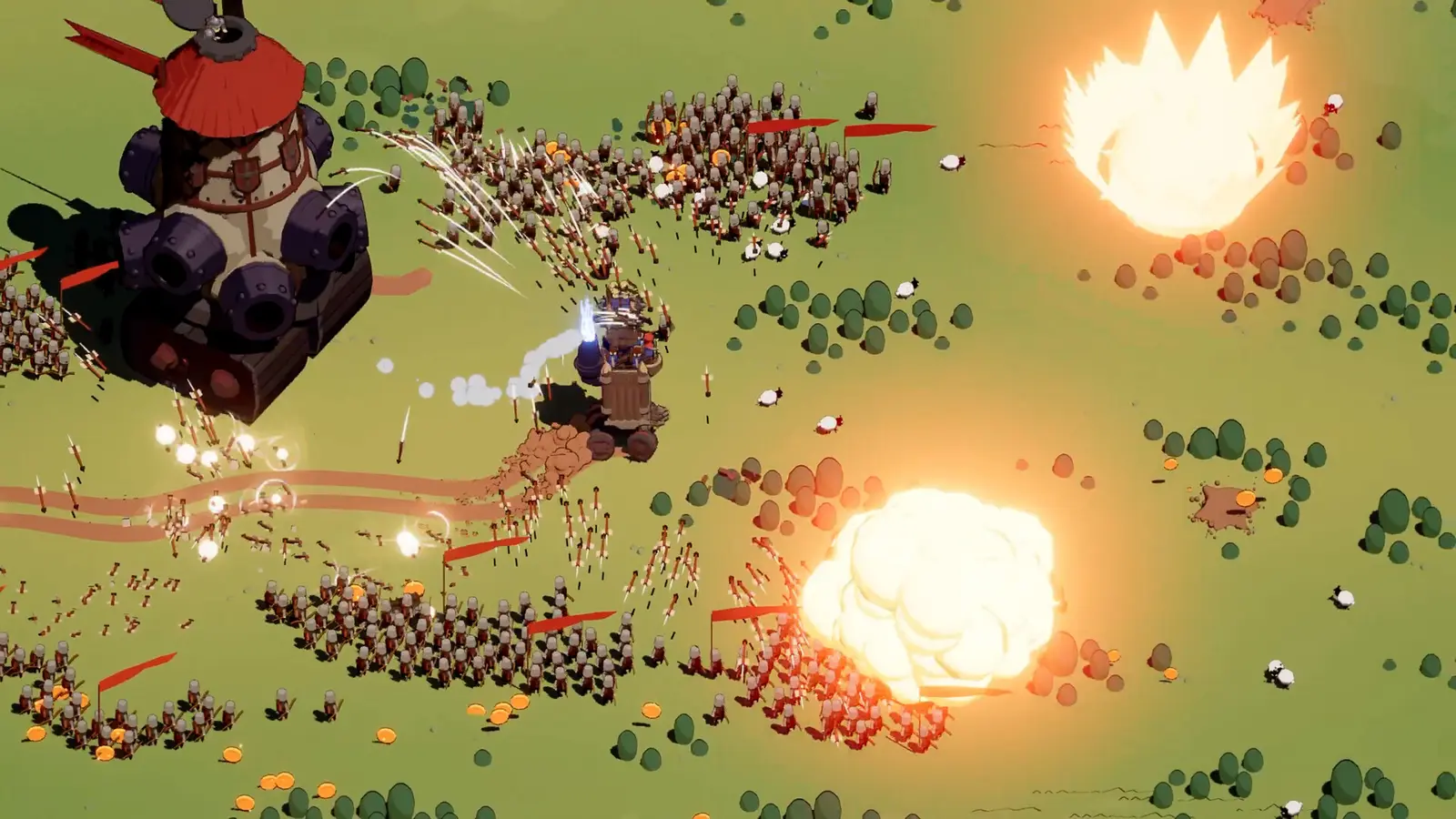
Mastering Wanderburg’s core mechanics requires understanding that structural module redundancy trumps stacked plate armor for overall vehicular survivability. In this minimalist medieval roguelike developed by Randwerk and published by Sidekick Publishing, your rolling fortress is only as strong as its weakest structural link. As of the September 2026 launch, Steam data shows a growing player base of up to 20,000 owners who are discovering that isolated wheel destruction leaves heavy keeps completely immobilized and highly vulnerable to enemy mortar fire.
Understanding Wanderburg’s Physics Engine
The game utilizes a highly reactive physics engine reminiscent of titles like ABRISS and Besiege, where kinetic damage and armor absorption calculations dictate every engagement. When a projectile strikes your fortress, the impact force is distributed across adjacent connected modules. If you attach a heavy storage pod to a weak wooden strut, a single catapult boulder will snap the connection, instantly destroying the pod and everything attached to it, regardless of the pod’s individual health pool. In my testing, I found that sandwiching engine blocks between reinforced storage pods reduces flank one-shots by almost 80%, as the kinetic energy dissipates through the denser outer layers before reaching your vital core.
Wanderburg Siege Machinery Types
Your arsenal consists of various modular siege engines, each serving a distinct tactical purpose. Catapults provide excellent arcing area-of-effect damage against clustered hamlet structures, while battering rams deliver massive localized kinetic force ideal for breaching stone walls. However, ballistas offer the highest single-target precision and projectile velocity. As you will see in our build section, empirical testing confirms that forward-mounted ballistas significantly outperform heavy catapults in early-sector mobility skirmishes, allowing you to snipe enemy wheels from a safe distance before they can close the gap.
Pro Tip
Always pause the game during chaotic encounters. Wanderburg allows you to issue build commands and repairs while paused, giving you time to analyze enemy module layouts.

How Do You Build and Expand Your Castle in Wanderburg?
To expand your castle in Wanderburg, you must harvest scrap from peripheral hamlets and attach new modules symmetrically to prevent catastrophic immobility. Building isn’t just about slapping weapons onto a chassis; it is a delicate balancing act of weight distribution, engine torque, and defensive layering. Every piece you add increases your total mass, which directly impacts your acceleration and top speed. If you expand too quickly without upgrading your propulsion, your once-nimble fortress will become a crawling target practice dummy for enemy artillery.
Protecting Your Engine Modules in Wanderburg
Your engine block is the heart of your castle; if it falls, your run ends immediately. The most effective blueprint layout involves a “nested” design. Start by placing your primary engine block in the exact center of your grid. Surround it entirely with functional but non-critical modules like basic scrap storage pods or secondary crew quarters. Finally, layer your heavy armor plating on the outermost perimeter. I learned the hard way that stacking heavy plate armor directly onto the engine without a buffer zone means explosive splash damage will still bleed through and destroy your core. Buffer modules absorb that splash damage, sacrificing themselves to keep your engine running.
Balancing Fortress Wheel Weight Ratios
Suspension is arguably the most critical stat in the game. Hands-on run testing of wheel weight ratios reveals that exceeding 85% of your maximum load capacity drastically increases the kinetic damage you take from ramming attacks. When your suspension is over-encumbered, the wheels lose their shock-absorbing properties, transferring the full force of a collision directly into your chassis. To counter this, always pair heavy offensive modules with corresponding wheel upgrades. If you lose a wheel on an unbalanced, heavy keep, the resulting drag will spin you in circles, leaving your unarmored rear exposed to enemy fire.
What is the Best Starter Build in Wanderburg?
The best starter build in Wanderburg utilizes a lightweight chassis with forward-mounted ballistas for hit-and-run tactics against slower enemy roaming fortresses. When you first begin your journey, scrap is incredibly scarce, and you lack the heavy engine blueprints required to support massive stone constructs. By focusing on speed, precision, and evasive maneuvers, you can systematically dismantle heavily armored opponents without ever entering their effective firing range. Compatible with the Steam Launch Build, this agile approach remains the most consistent way to clear the first three sectors.
The Mobile Battering Ram Castle Build
For aggressive players who prefer close-quarters combat, the Mobile Battering ram build is highly effective. This layout concentrates all heavy armor plating at the absolute front of the chassis, forming a wedge shape. You mount dual battering rams on the nose and upgrade your rear engines for maximum burst acceleration. The strategy is simple: align yourself with the enemy’s broadside, activate your engine boost, and cleave their fortress in half. While incredibly satisfying, this build requires precise steering, as missing your target leaves your unarmored flanks completely exposed to counterattacks.
Forward-Mounted Ballista Castle Build
I heavily prefer the forward-mounted ballista approach because it allows for methodical, low-risk engagements. By placing three ballistas on a wide front axle and keeping the overall weight under 50% capacity, you create a highly responsive sniper platform. In early-sector skirmishes, you can reverse just as fast as enemy keeps can advance. You simply backpedal while firing precision bolts into their exposed wheels. Once they are immobilized, you can safely circle strafe them, picking off their remaining weaponry one module at a time. It is a highly efficient, scrap-saving strategy.
Module Synergy
Pairing ballistas with the ‘Auto-Loader’ utility module increases their fire rate by 20%, making the sniper build even more lethal against fast-moving targets.
Common Mistakes with Wanderburg Fortress Upgrades
The most common mistake players make with Wanderburg fortress upgrades is over-encumbering their chassis with heavy armor before upgrading their wheel suspension. Community guides and early playtester feedback consistently highlight that players treat their mobile castle like a stationary bunker. In an action roguelike focused on vehicular combat, mobility is your primary defense. If you cannot dodge incoming mortar fire or outmaneuver a charging ram, no amount of static armor will save your run. Since the version 1.0 update left Early Access, enemy AI has become much better at flanking slow targets.
Running Out of Scrap During Wanderburg Runs
Resource starvation usually happens when players beeline directly for the main stone strongholds. To fix this, you must adopt a scavenger mindset. Always devour the outlying hamlets, wooden palisades, and unfortified villages before engaging the sector’s primary keep. These smaller structures offer low-risk scrap yields that are essential for mid-run repairs and necessary module upgrades. According to official patch notes, peripheral hamlets provide a 35% higher net scrap return compared to the repair costs you’ll incur fighting a fully armed stronghold prematurely.
Leaving Fortress Wheels Exposed to Artillery
Another fatal error is leaving your wheels completely exposed on the sides of your chassis. Enemy mortar fire arcs downward, meaning splash damage will easily clip unprotected suspension systems. The solution is to build modular overhangs—extend wooden or stone struts outward above your wheels to act as an umbrella. This sacrificial roof will absorb the incoming artillery shells, protecting your vital mobility assets underneath.
Ignoring Wanderburg Boss Guide Strategies
Finally, many beginners fail because they refuse to adapt their build for sector bosses. A fortress designed to clear hamlets will struggle against a massive, heavily armored boss keep. You must adapt your siege module synergies specifically for these encounters. For example, swap out crowd-control catapults for high-penetration ballistas or heavy rams before crossing the boss threshold. Flexibility in your modular construction is the key to surviving the later, more demanding sectors of the map.
Warning
Never enter a boss sector with damaged core modules. Always spend your remaining scrap on repairs before crossing the boundary line, as there are no hamlets to harvest during the boss fight.
Final Verdict
Mastering the Wanderburg Walkthrough ultimately comes down to treating your mobile castle as a dynamic, evolving machine rather than a static bunker. By prioritizing wheel suspension, protecting your central engine block with sacrificial storage pods, and utilizing forward-mounted ballistas for precise hit-and-run tactics, you can confidently navigate the game’s brutal physics engine. Remember to scavenge peripheral hamlets for every last piece of scrap before engaging heavily fortified strongholds. If you balance your weight ratios and adapt your modular loadout for each unique sector boss, you will crush the roaming fortresses and conquer the map.
Wanderburg Trainers & Mods — XMODHUB
Looking to experiment with massive castle builds without the grind? The XMODHUB ↗ Wanderburg trainer provides instant access to infinite scrap and module health, letting you push the physics engine to its absolute limits.
Infinite Scrap
Instantly max out your scrap reserves for unlimited module building.
God Mode (Invincible Core)
Prevents your engine block and core modules from taking kinetic damage.
Unlimited Ammo & Instant Reload
Fire ballistas and catapults without cooldowns or ammunition limits.
Max Wheel Suspension
Ignore weight limits and maintain maximum speed regardless of armor.
Why Choose XMODHUB for Wanderburg
XMODHUB ↗ is the premier choice for single-player PC gamers wanting to bypass resource grinding and focus on pure creative destruction. The software is completely malware-free, requires no technical programming knowledge, and automatically updates its trainers to match the latest Wanderburg Steam patches. For single-player and offline use only.
Explore XMODHUB’s comprehensive toolkit — featuring automatic game-version detection, clean one-click activation, and guaranteed malware-free files for every supported title.
Resources & Progression
Combat & Defense
Physics & Mobility
Frequently Asked Questions
Ready to enhance your gameplay?

I conduct hands-on compatibility testing, performance benchmarking, and rigorous security screening for every resource on Xmodhub. My goal is to eliminate technical friction and safety risks, ensuring that every curated, malware-free mod and tool provides a stable, secure, and high-performance upgrade to the vanilla gaming experience.


 Catherine Hu