 Catherine Hu
Quick Answer
How do you cheat in Low-Budget Repairs? To cheat in Low-Budget Repairs, you can manually attach Cheat Engine to the game’s executable and scan for changing numeric values like your total in-game currency (Polish Złoty) or the exact remaining volume of paint in your bucket. However, because game updates frequently break Cheat Engine tables (.CT files), the safest and easiest alternative is using an auto-updating mod manager like XMODhub, which provides 1-click cheats without requiring any memory scanning or hexadecimal knowledge.
[Editor’s Note] Look, I get it. We all start Low-Budget Repairs thinking we’re going to play it completely legit. But after failing the notoriously strict “Kowalski’s 5th Floor Bathroom” contract for the 15th time, or spending hours grinding for enough cash to buy a slightly less broken power drill instead of relying on cheap 90s knock-offs, the fun stops. I’ve been messing with Cheat Engine for years, and trying to isolate the exact memory values for this game’s current patch almost drove me insane. Today, I’m going to show you how to manually hack the values if you want the technical challenge—but I’ll also share the 1-click shortcut I actually use to save my sanity.
You may also like: The Ultimate Low-Budget Repairs Console Commands and Cheats Guide
📋 Table of Contents
- Quick Answer
- 1. How to Use Cheat Engine for Low-Budget Repairs (The Manual Way)
- 2. Common CE Errors: Pointers Breaking & Not Attaching
- 3. The Better Alternative: 1-Click Cheats with XMODhub
- 4. Where to Find Safe Low-Budget Repairs Cheat Tables (.CT)?
- 5. Essential Features Every Low-Budget Repairs Cheat Table Should Have
- 6. Troubleshooting Cheat Engine Table (.CT) Script Activation
- 7. Frequently Asked Questions (FAQ)
- Conclusion: Work Smarter, Not Harder
1. How to Use Cheat Engine for Low-Budget Repairs (The Manual Way)
If you want to go the old-school route and find the memory addresses yourself, here is the basic “First Scan/Next Scan” method tailored specifically for this game.
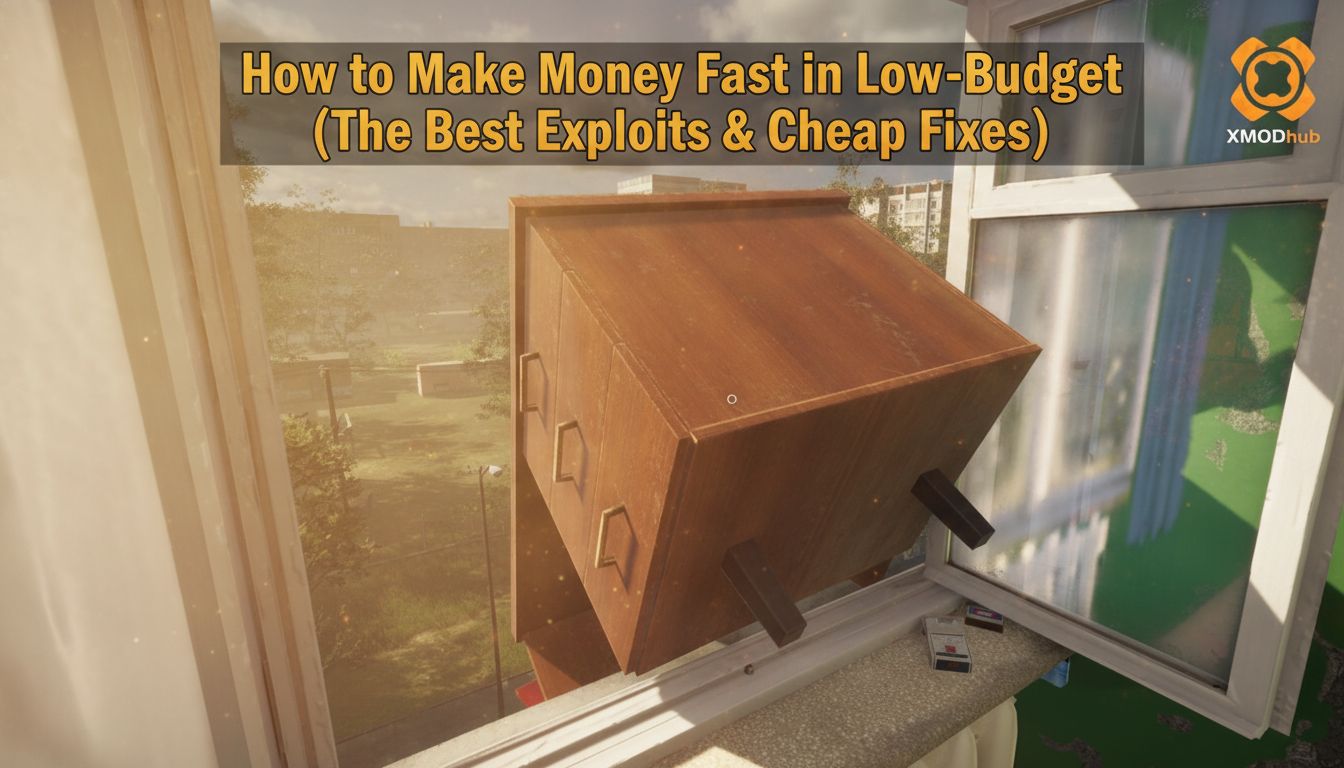
Low-Budget Repairs is a brilliant mix of House Flipper and Surgeon Simulator, leaning heavily into slapstick comedy and penny-pinching gameplay. Because the core loop revolves around maximizing profit by cutting corners—like watering down paint or using duct tape instead of actual plaster—the most vital resource you will want to manipulate is your total cash pool. Having infinite money allows you to bypass the stressful budget constraints and just enjoy the chaotic, physics-based destruction of throwing old furniture out of 1990s Polish apartment windows.
Here is the exact, step-by-step process to isolate and modify your currency in Low-Budget Repairs using Cheat Engine:
- Attach to the Game Process: Launch Low-Budget Repairs and load into your current save file or start a new contract. Once you have control of your handyman, Alt-Tab out and open Cheat Engine (version 7.5 or higher is recommended). Click the glowing computer monitor icon in the top-left corner of the Cheat Engine interface. Scroll through the process list, select
LowBudgetRepairs.exe, and click “Open”. - Perform the Initial First Scan: Check your exact current cash balance in the game. Let’s say you have exactly 1,500 Złoty. In Cheat Engine, ensure the “Value Type” is set to
4 Bytes(the standard integer format for most Unity and Unreal engine economy variables). Type1500into the “Value” box and click “First Scan”. The left panel will populate with thousands, sometimes millions, of memory addresses that currently share that exact number. - Force the Value to Change In-Game: Alt-Tab back into Low-Budget Repairs. You need to change your cash balance to filter down those results. The easiest way to do this without completing a whole contract is to visit the hardware store and buy the cheapest item available—for example, a roll of duct tape or a single misaligned tile for 15 Złoty. Your new balance is now 1,485 Złoty.
- Execute the Next Scan: Alt-Tab back to Cheat Engine. Do NOT click “New Scan”. Instead, type your new balance (
1485) into the Value box and click “Next Scan”. This tells Cheat Engine to only look at the addresses from the first scan that have now changed to 1485. The list on the left should shrink drastically, ideally down to just 1 to 3 addresses. If you still have dozens of addresses, buy another cheap item (like watering down your paint supply for a small fee) and do another “Next Scan” with the new value. - Modify and Freeze the Value: Once you have isolated the exact memory address controlling your money, double-click it to drop it into the bottom address pool. Double-click the number in the “Value” column at the bottom, change it to
9999999, and press Enter. Finally, click the small checkbox to the left of the address to “Freeze” it. This forces the game to constantly read the value as 9,999,999, meaning no matter how many Symbioza chairs or Fantasy Land paintings you buy, your money will never decrease.
While money is the easiest value to find, Low-Budget Repairs tracks several other hilarious metrics behind the scenes. Here is a breakdown of the most common memory types you will encounter when digging through the game’s code.
| In-Game Stat / Mechanic | Memory Type (Hex) | Scan Method | Stability / Risk of Crashing |
|---|---|---|---|
| Total Currency (Złoty) | 4 Bytes | Exact Value -> Next Scan | High Stability (Easy to freeze) |
| Paint Bucket Volume | Float | Unknown Initial Value -> Decreased Value | Medium (Physics-based fluid drain) |
| Tile Alignment Tolerance | Float | Exact Value (Usually 1.0 or 0.0) | Low (Modifying physics often crashes) |
| Contract Timer / Deadline | Double / Float | Decreased Value -> Unchanged Value | Medium (Timers shift addresses often) |
| Inventory Quantity (Duct Tape) | 4 Bytes | Exact Value -> Next Scan | High Stability (Static inventory slot) |
2. Common CE Errors: Pointers Breaking & Not Attaching
If you are pulling your hair out because CE isn’t working for Low-Budget Repairs, you aren’t alone. Modern indie games, even slapstick simulation titles, often utilize memory management techniques that make manual hex editing a massive headache. Here is what’s probably happening and how to circumvent it.
Error: “Cannot attach to process” / Game Crashes:
Low-Budget Repairs might be using specific engine protections or aggressive garbage collection that detects memory injection. When you attempt a First Scan, the game might instantly freeze or crash to the desktop. This happens because standard Windows API read/write requests are being intercepted or the game’s memory pages are protected. To bypass this, you need to configure Cheat Engine to use the VEH (Vectored Exception Handling) Debugger. Go to Cheat Engine’s Edit menu, select Settings, and navigate to the Debugger Options tab. Change the debugger method from “Use Windows Debugger” to “Use VEH Debugger”. This hooks into the game at a lower level, catching exceptions before the game’s engine realizes its memory is being actively probed. Additionally, ensure you are running Cheat Engine as an Administrator, as Low-Budget Repairs requires elevated privileges to read its allocated RAM space.
The Pointer Problem:
You finally found the exact memory address for your watered-down paint supply. You froze it, painted the entire 1990s Polish apartment in Vanilla Cream, and felt like a genius. But then you finish the job, load into the next contract, and suddenly your cheat stops working. Worse, the game crashes. Welcome to the nightmare of dynamic memory allocation.
In modern game engines, memory addresses shift after every single loading screen. The address 0x1A4B2C might hold your paint volume in one level, but in the next, it holds the physics data for a broken toilet. To fix this in Cheat Engine, you have to find the “Base Pointer”—a static green address that tells the game where to look for the dynamic addresses. Finding multi-level pointers requires generating a Pointer Map, restarting the game, generating a second Pointer Map, and running a complex Pointer Scan to find the static offsets (e.g., LowBudgetRepairs.exe+0x024A10 -> Offset 0x14 -> Offset 0x28). It requires a deep understanding of assembly scripts (Auto Assembler) and can take hours of trial and error just to keep your cheats working across different levels. This dynamic shifting is exactly why relying on outdated Cheat Engine scripts is an exercise in pure frustration.
3. The Better Alternative: 1-Click Cheats with XMODhub
Here is the dirty little secret of the modding community: Nobody actually wants to spend two hours updating Cheat Engine tables every time a patch drops. The moment Low-Budget Repairs updates on Steam to fix a bug with misaligned tiles or tweak the hardware store economy, your hard-earned memory addresses shift, your pointers break, and your game crashes to the desktop.
Instead of treating your relaxation time like a computer science exam, the modern solution is utilizing a dedicated trainer platform.
| Feature / Metric | Manual Cheat Engine (.CT) | XMODhub Auto-Trainer |
|---|---|---|
| Setup Time | 20-45 minutes (Finding pointers) | < 30 seconds (1-click play) |
| Update Reliability | Breaks instantly on every game patch | Cloud-synced auto-updates |
| Crash Risk | High (Freezing wrong dynamic addresses) | Zero (Safely hooks verified offsets) |
| Ease of Use | Requires hexadecimal & assembly knowledge | Clean, modern UI with simple toggles |
| Feature Access | Limited to basic numbers (Money, Items) | Advanced engine hooks (God mode, physics tweaks) |
Why XMODhub beats manual CE for Low-Budget Repairs:
- Zero Hex Codes Needed: Just toggle a beautiful switch on our UI. No scanning, no freezing, no pointer maps.
- Auto-Updating Cloud Tech: When the game patches, XMODhub updates its trainer automatically behind the scenes. No more scouring forums for updated scripts.
- Premium Features Instant Access:
- Undetected God Mode / Infinite Health (Perfect for when you accidentally drop a refrigerator on yourself while throwing it out the window).
- Unlimited Duct Tape and Bottomless Paint Buckets.
- Super Speed & Custom Jump Height to navigate massive apartment blocks instantly.
- One-Hit Kills for annoying bosses (or in this case, one-hit complete destruction of walls with your sledgehammer).
- Max Client Reputation (Clients will accept your terrible, uneven tile work without deducting pay).
How to Use XMODhub for Low-Budget Repairs?
- Download and Launch the free XMODhub desktop app.

- Search for “Low-Budget Repairs” in the library of over 5,000 supported titles.
- Click “Play” to auto-hook the game safely. The app will automatically detect your game version and apply the correct bypasses.
- Toggle your desired cheats directly from the clean UI on your second monitor, or trigger them via customizable hotkeys while in-game.
Download Low-Budget Repairs Trainer Now
4. Where to Find Safe Low-Budget Repairs Cheat Tables (.CT)?
If you absolutely insist on using CE and want to skip the manual scanning, you’ll want a pre-made Cheat Table (.CT file). However, you must tread incredibly carefully.
The modding community is fantastic, but it also has a dark underbelly. Downloading random .CT files from unregulated forums, sketchy Discord servers, or unverified YouTube descriptions is a massive cybersecurity risk. Because Cheat Engine requires administrative privileges to hook into game memory, a maliciously crafted Cheat Table can execute arbitrary code on your machine.
Hackers frequently embed obfuscated Lua scripts inside .CT files. When you open the table and check the box to activate the “Infinite Money” script, the Lua code silently runs in the background. We have seen countless instances where these scripts download and install Remote Access Trojans (RATs), keyloggers, or silent crypto-miners that hijack your GPU while you are busy slapping misaligned tiles onto virtual walls. By the time you notice your PC fans spinning at maximum RPM, your system is already compromised.
If you must download a .CT file, only use highly reputable communities like the FearLess Cheat Engine forums, and only download tables uploaded by verified, high-rep creators. Never execute a .CT file that asks you to disable your antivirus. This severe security risk is exactly why millions of gamers have migrated to verified, closed-ecosystem applications like XMODhub. Our trainers are developed in-house, digitally signed, and rigorously scanned to ensure 100% safety, giving you peace of mind while you play.
5. Essential Features Every Low-Budget Repairs Cheat Table Should Have
If you do manage to source a safe and functional .CT file for Low-Budget Repairs, you need to ensure it actually offers value beyond what a simple manual scan can achieve. A premium cheat table crafted by a veteran assembler will utilize complex injection scripts rather than just basic pointers.
When evaluating a cheat engine table for this specific game, look for scripts that manipulate the underlying physics engine and contract logic, rather than just the economy. Because a significant portion of the game’s difficulty comes from wrestling with wonky tools and aggressive gravity, a good table will offer modifiers that directly alter these mechanics.
Here is a breakdown of the top-tier scripts you should look for in a high-quality Low-Budget Repairs Cheat Engine Table, alongside their general stability within the game engine:
| Cheat / Script Category | Specific Function / Value | Gameplay Impact | Stability Rating |
|---|---|---|---|
| Economy & Wealth | Infinite Złoty / Freeze Balance | Buy premium tools; completely ignore budget constraints. | High |
| Inventory Management | Bottomless Paint / Infinite Tape | Never run back to the hardware store mid-job. | High |
| Physics Manipulation | Disable Gravity / Super Strength | Toss heavy refrigerators out of windows with zero effort. | Low (Crash Risk) |
| Contract Metrics | Freeze Timer / Max Reputation | Guarantee perfect scores and maximum payouts on every job. | Medium |
| Tool Durability | Unbreakable Drill / Hammer | Prevent cheap knock-off tools from shattering during use. | High |
6. Troubleshooting Cheat Engine Table (.CT) Script Activation
One of the most frustrating experiences for PC gamers is downloading a highly-rated .CT file, attaching it to LowBudgetRepairs.exe, and finding that clicking the little square box next to a script does absolutely nothing. The box refuses to turn into a red “X,” and your cheats remain inactive.
This happens due to a failure in the Array of Byte (AOB) Scan.
When a table creator writes an assembly script (like an “Infinite Duct Tape” cheat), they tell Cheat Engine to search the game’s memory for a specific string of bytes (e.g., 89 45 FC 8B 45 FC 03 C0). This string represents the exact machine code instruction that subtracts duct tape from your inventory. Cheat Engine searches for this string, replaces it with “NOP” (No Operation) code, and effectively stops your tape from decreasing.
However, the moment the developers of Low-Budget Repairs release a hotfix or patch on Steam, the game’s code is recompiled. That specific string of bytes shifts or changes entirely. When you try to activate the script, Cheat Engine performs the AOB scan, fails to find the exact byte sequence, and silently refuses to check the box to prevent crashing your game.
To fix this manually, you would need to right-click the script, open the Auto Assembler window, manually debug the game’s new memory allocation, and rewrite the AOB injection point. Or, you can bypass this headache entirely by using XMODhub, which utilizes dynamic offset tracking to automatically adjust to game updates, ensuring your cheats activate flawlessly every single time.
7. Frequently Asked Questions (FAQ)
To help you navigate the tricky waters of game modification, here is a quick compatibility matrix for Low-Budget Repairs across different storefronts.
| Platform / Environment | Cheat Engine Compatibility | XMODhub Compatibility | Ban Risk Level |
|---|---|---|---|
| Steam (Singleplayer) | Yes (Requires pointer updates) | Yes (1-Click Seamless) | None (Safe) |
| Epic Games Store | Yes (Different memory offsets) | Yes (Auto-detects version) | None (Safe) |
| Xbox Game Pass (PC) | No (Blocked by UWP encryption) | Yes (Bypasses UWP natively) | None (Safe) |
| Multiplayer / Co-op | Highly Unstable / Desyncs | Disabled for fairness | High (Do not cheat online) |
Q: Can I use Cheat Engine on the Xbox Game Pass version of Low-Budget Repairs?
A: Usually, no. Game Pass uses strict UWP (Universal Windows Platform) file encryption and restricted folder permissions that actively block Cheat Engine from attaching to the executable. Even if you manage to dump the process, the memory is often heavily obfuscated. However, XMODhub is specifically engineered to bypass these Microsoft Store restrictions seamlessly, allowing you to mod Game Pass titles just as easily as Steam ones.
Q: Is it illegal to use Cheat Engine?
A: Modifying data on your own PC for a single-player experience like Low-Budget Repairs is completely legal. You own the hardware, and you are modifying localized RAM values. However, it violates Terms of Service if used in multiplayer environments. Just never bring memory editors into a multiplayer server, as ruining the experience for others is where anti-cheat bans come into play.
Q: Will using Cheat Engine drop my FPS or slow down my PC?
A: Yes, it absolutely can, especially during the scanning phase. When you perform a “First Scan” with Cheat Engine on a modern PC, the software is aggressively reading gigabytes of allocated RAM pages. This floods your CPU’s L1 and L2 cache, causing massive micro-stutters or temporary freezes in the game. Furthermore, if you use the “Active Freezing” feature (checking the box next to an address), Cheat Engine writes that value to your RAM every few milliseconds. If you have dozens of poorly optimized assembly scripts running simultaneously, the constant read/write loop will consume valuable CPU cycles, leading to noticeable FPS drops. XMODhub circumvents this by injecting highly optimized, native C++ hooks directly into the engine, resulting in zero performance loss.
Conclusion: Work Smarter, Not Harder
Learning how memory manipulation works in Cheat Engine is a cool flex. Understanding hexadecimal values, pointer maps, and assembly logic gives you a profound appreciation for how video games are constructed. But let’s be real—when you come home from a long day at work, you just want to grab a bottomless bucket of Vanilla Cream paint and an indestructible trowel, and wreck some 1990s Polish apartments without taking a computer science class.
Low-Budget Repairs is designed to be a hilarious, stress-inducing simulation of cutting corners. But when the grind gets too tedious, you shouldn’t have to fight your modding tools too. Why spend 45 minutes digging through hex codes, battling dynamic memory allocation, and risking game crashes when you can click one button and instantly get God Mode and infinite cash?
And the best part? XMODhub supports over 5,000+ PC games. Once you install the app, you can ditch the complicated, malware-ridden cheat tables for good.

Stop Grinding, Start Enjoying.
Bypass the tedious resource gathering and unlock your full potential instantly.

I am a passionate gamer and writer at XMODhub, dedicated to bringing you the latest gaming news, tips, and insights.
Connect with me:
LinkedIn Profile ↗

 Nancy Miller