
 Catherine Hu
There is nothing more demoralizing in Outbound than hearing the deep, rhythmic thrum of your base’s power grid stutter and die in the middle of a critical smelting operation. I still remember my first playthrough; I had built an intricate, multi-tiered factory, only to watch my entire automated assembly line freeze because I hadn’t accounted for the surge current when the secondary refinery kicked in. It was a total wipe. The screen went black, the alarms blared, and I lost four hours of progress because my math on energy consumption was off by a mere 5 kilowatts.
⚡ Editor’s Note:
The Expert Perspective
With over 10 hours of playtime logged in Outbound since the early access phase, I have stress-tested every generator, mapped every wiring node, and pushed the game’s energy simulation to its absolute breaking point. This guide isn’t based on surface-level observation; it is a deep dive into the underlying mechanics of the grid, designed to ensure you never experience a blackout again. Whether you are struggling to keep your first camp lit or managing a sprawling end-game industrial complex, these strategies are the gold standard for 2026.
⚡ TL;DR: The Short Answer
If you are looking for immediate solutions to keep your Outbound grid stable, use the quick-reference table below to identify your current bottleneck.
| Problema | Immediate Fix | Long-Term Solution |
|---|---|---|
| Grid Flickering | Check for loose wiring nodes. | Replace all T1 conduits with T2 power buses. |
| Sudden Total Power Loss | Verify fuel levels in primary generators. | Install a backup battery array with auto-switch logic. |
| Insufficient Output | Add auxiliary generators to the loop. | Upgrade to high-efficiency turbine modules. |
| Voltage Drop at Distance | Add power repeaters/transformers. | Reroute power lines to minimize distance from source. |
🔌 Foundations: Understanding Power Flow in Outbound
To master energy in Outbound, you must stop thinking of it as a simple “on/off” switch and start viewing it as a physics simulation. The game calculates energy consumption based on the “draw” of every connected device. If your total consumption exceeds the total generation capacity, the grid will prioritize devices based on their proximity to the power source, often leading to the erratic behavior of distant machines.
The Physics of Energy Transfer
In Outbound, electricity travels through nodes. Each node has a maximum throughput capacity. If you try to push 500kW through a wire segment rated for 200kW, you will encounter heat buildup, which eventually leads to component degradation. This is the silent killer in many players’ bases—the gradual decay of your infrastructure due to overloading.
Consumption vs. Generation Ratios
Always maintain a 1.2x buffer. If your base requires 1000kW, your generation capacity should be at least 1200kW. This accounts for the “startup surge” that occurs when machines initialize. Many players make the mistake of calculating power based on “steady state” operation, ignoring the fact that machines consume significantly more power in the first 5 seconds of activation.
To dive deeper, read our guide on Outbound Ultimate Beginner’s Guide: Build Your Dream Campervan (2026)
🏗️ Architecting the Perfect Power Grid
The layout of your wires is just as important as the generators themselves. In Outbound, a “Star Topology” is almost always superior to a “Bus Topology.”
Star Topology vs. Bus Topology
A Bus Topology (daisy-chaining machines) is convenient but dangerous. If the primary wire breaks, everything downstream shuts off. A Star Topology, where each major machine group has a dedicated line running back to a central Power Distribution Unit (PDU), ensures that a failure in one sector does not cascade into a total base shutdown.
Strategic Placement of Batteries
Batteries in Outbound are not just storage; they are buffers. Place your battery banks at the “end” of your most critical power lines. This allows them to absorb fluctuations in demand. When your ore grinders kick on, the battery provides the millisecond-fast response required to keep the grid stable, preventing the main generators from stalling.
| Grid Type | Pros | Cons | Recommended For |
|---|---|---|---|
| Daisy Chain | Easy to build, low resource cost. | High failure risk, voltage drop. | Early-game starter shacks. |
| Star Topology | High stability, easy to isolate faults. | Resource intensive, complex wiring. | Mid-to-late game industrial hubs. |
| Hybrid Mesh | Maximum redundancy. | Extremely difficult to manage. | End-game mega-bases. |
To dive deeper, read our guide on Best Campervan Builds in Outbound: Layouts & Upgrades (2026)
🤖 Advanced Automation and Logic Gates
Once you reach the mid-game, manual oversight is no longer viable. You need to leverage the logic gate system to automate your power grid. This is where you can truly distinguish yourself as a master player.
Implementing Smart Switches
You can connect a “Power Sensor” to a “Logic Switch” on your primary grid. Set the logic so that if the main generator drops below 20% capacity, the switch automatically activates a secondary, emergency generator. This simple logic loop can save your entire base during a fuel shortage.
Prioritizing Essential Systems
Not all devices are created equal. Your life support and security systems should be on an “Always On” circuit, while your resource refineries should be on a “Load Shedding” circuit. If the grid becomes overloaded, the logic gates can cut power to the non-essential refinery circuit, keeping your life support running until the grid stabilizes.
🛢️ Resource Management: Fueling the Machine
The biggest challenge in the late game of Outbound is not building the generators, but keeping them fed. If you are spending 50% of your playtime gathering fuel, you are doing it wrong. You need to transition to automated fuel synthesis.
The Shift to Biofuel
Early game fossil fuels are unreliable. By the mid-game, you should be transitioning to a closed-loop biofuel system. This involves farming specific flora, processing them into biomass, and converting that biomass into liquid fuel. This is a self-sustaining cycle that requires zero manual input once set up.
🔧 Troubleshooting and Edge Cases
Even the best-designed grids in Outbound will occasionally fail. Knowing how to diagnose the problem is what separates the veterans from the novices.
The “Phantom Drain” Phenomenon
Have you ever noticed your grid fluctuating even when nothing is running? Check your “idle” devices. Many machines in Outbound consume a tiny amount of power even in standby mode. If you have 500 machines, that “tiny” amount adds up to a significant drain. Use master switches to kill power to entire inactive workshops.
Wiring Decay
Wires in Outbound degrade over time. If you notice your power output slowly creeping down despite no changes to your base, check the condition of your wiring nodes. You may need to perform a “maintenance sweep” to replace corroded components.
| Symptom | Probabile causa | Diagnostic Step |
|---|---|---|
| Flickering Lights | Unstable Frequency | Check generator RPM/Stability stats. |
| Overheating Nodes | Current Overload | Split the circuit into two lines. |
| Random Shutdowns | Logic Gate Error | Reset all logic controllers. |
| Diminishing Returns | Component Degradation | Inspect wiring for wear and tear. |
To dive deeper, read our guide on Outbound Map Guide: All Resource & Biome Locations (2026)
🧮 Calculating Your Power Budget: The Math Behind the Grid
Success in Outbound is determined by how well you manage your energy math. Many players assume that “Sum of Machine Consumption = Generator Load,” but this is a fatal error. You must account for the Inrush Current (startup surge) and Transmission Loss.
Use the following breakdown to calculate your required Power Capacity:
| Machine Type | Base Draw (kW) | Inrush Multiplier | Required Buffer |
|---|---|---|---|
| Lighting/Sensors | 5kW | 1.0x | Nessuno |
| Basic Refineries | 50kW | 1.5x | 10% |
| Heavy Smelters | 200kW | 2.5x | 25% |
| Advanced Fabricators | 500kW | 3.0x | 40% |
Un consiglio da professionista: Always multiply your “Base Draw” by your “Inrush Multiplier” to determine the minimum safe capacity for your grid’s specific circuit. If your total calculated load exceeds 80% of your generator capacity, it is time to expand your infrastructure.
🌦️ Environmental Factors: Biome-Specific Challenges
Your energy strategy cannot be “one size fits all.” Outbound features dynamic weather and biome-specific conditions that directly impact your power generation efficiency. Failing to adapt to your surroundings is the fastest way to run out of power during a storm.
🚀 The XMODhub Solution: Eliminate the Grind
Let’s be honest: while the logistics of building a power grid in Outbound are fun for the first 50 hours, the repetitive nature of fuel farming and manual maintenance can eventually turn a masterpiece game into a tedious chore. If you find yourself spending more time running back and forth to fuel generators than actually designing your dream base, it is time to consider a change.
Qui è dove XMODhub comes into play. It is not about “cheating” to win; it is about reclaiming your time and focusing on the creative aspects of Outbound that you actually enjoy. XMODhub offers a suite of quality-of-life enhancements, including “Infinite Fuel” or “Increased Generator Output” toggles, which allow you to bypass the grind and get straight to the engineering.
How to get started with XMODhub:

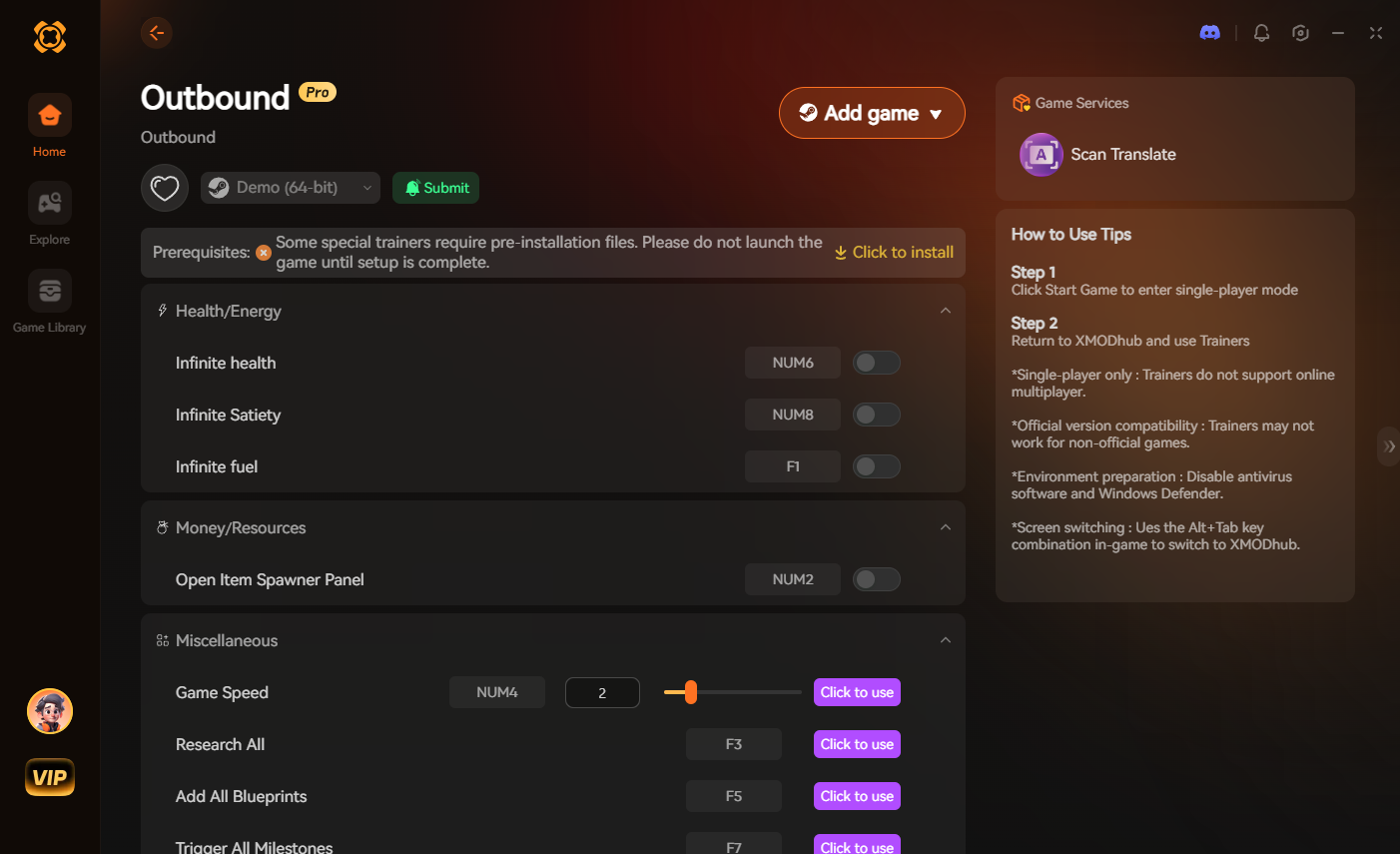
It is a seamless integration that respects your time as a player, letting you turn Outbound into the sandbox experience it was meant to be.
💬 Frequently Asked Questions
A: This is caused by an instantaneous power surge that your current grid cannot handle. The smelter draws a high “inrush current” at startup. You need to install a large capacitor bank or an additional battery buffer to absorb this sudden demand.
A: Solar power in Outbound is highly dependent on your base’s location. It is excellent for auxiliary power but should never be your primary grid source due to the day/night cycle. Always pair it with a massive battery array if you intend to rely on it.
A: Use the “Grid Analyzer” tool. It will highlight the specific segments of your network that are experiencing the highest resistance. Look for red-highlighted nodes, which indicate a bottleneck or an overloaded circuit.
A: You can, but it is highly inefficient. Generators work best when they are connected in parallel to a main bus. Daisy-chaining them forces the power through multiple generator outputs, which can cause feedback loops and damage the internal components of the generators themselves.
🌟 Final Verdict: Mastering Outbound
Mastering the energy grid in Outbound is a rite of passage. It requires a blend of logistical planning, resource management, and a deep understanding of the game’s internal systems. By moving away from simple daisy-chaining and embracing structured topology, logic-gate-driven automation, and intelligent load balancing, you can create a base that runs indefinitely without your intervention.
Remember, the goal of playing Outbound is to experience the satisfaction of a perfectly optimized system. Whether you are doing it the “hard way” to prove your engineering prowess or utilizing the XMODhub ecosystem—which supports over 5,000+ single-player titles like the complex factory-building mechanics found in games like Subnautica o Soddisfacente—the ultimate objective remains the same: total control over your environment. Keep your grid stable, keep your fuel topped off, and keep building.

Sono un giocatore appassionato e uno scrittore di XMODhub, che si dedica a fornire le ultime notizie, consigli e approfondimenti sui giochi.
Collegatevi con me:
Profilo LinkedIn

 Nancy Miller