
 Catherine Hu
You just zoned a massive new industrial sector. You have fifty Plebeians mining clay, chopping wood, and working the kilns. But when you check your Trade Port, you have zero Pottery to sell, your treasury is draining, and your Equites are threatening to leave because their markets are empty.
Failing to understand the physical logistics in Lion Shield’s city builder will completely paralyze your Roman empire. Nova Roma does not magically teleport items from a mine to a market. Every single piece of clay, wood, and iron must be physically carried by a worker or an ox-cart.
If you are constantly facing “Storage Full” or “Missing Materials” errors, this guide will break down the absolute best production chains in the game, how to optimize their physical layouts, and how to use memory tools to bypass the grueling industrial grind.
Ti potrebbe interessare anche: Nova Roma Cheat Engine Table vs. XMODhub: Best Free Trainer
Editor’s View: The “Spaghetti Logistics” Trap
“During my first campaign, I treated Nova Roma like a modern spreadsheet game. I put all my Clay Pits near the river, and then built a nice, neat row of Pottery Kilns all the way on the other side of the city near my markets. It was a disaster.”
“The Unity engine literally tracks the physical walking distance of every worker. My clay miners were spending 90% of their shift walking across town, getting stuck in traffic behind farmers, and dropping off a single lump of clay before going home. My industry completely collapsed.”
“You have to build ‘micro-districts’ where the raw material, the fuel, and the processing building are practically touching each other. When the traffic management gets too tedious, I honestly just use a spawner to fill my export depots.”
Logistics 101: Roads, Carts, and Storage Limits
Before we build a single factory, we need to address why your industries are stalling. In Nova Roma, production chains die in transit.
- The Carry Limit: A standard Plebeian worker can only carry 1 unit of a resource at a time. An Ox-Cart can carry 10 units. If you do not have dedicated hauling posts (Cart Depots) near your industrial zones, your factories will never get enough materials to operate continuously.
- Road Speeds: Dirt roads are for the early game. As soon as you establish a stone quarry, you must upgrade the roads connecting your resource hubs to your city center to Paved Stone. Paved roads increase walking and cart speed by 40%, drastically reducing the “Missing Materials” downtime.
- Storehouse Filtering: Never leave a Storehouse on its default “Accept All” setting. If you do, it will fill up with useless excess wheat, leaving no room for your expensive iron or wine. Click on a Storehouse and actively uncheck everything except the specific good you want stored there.
The Bread Chain (The Essential Backbone)
While not a high-value export, Bread is the most important production chain in the game. Without it, your citizens will starve, and immigration will flatline. The biggest mistake players make is building a 1:1 ratio of farms to bakeries.
The Optimal Bread Ratio: 3 Wheat Farms : 1 Windmill : 2 Bakeries
The Layout Strategy:
- The Agricultural Zone: Find a large, flat plain with high fertility. Group your 3 Wheat Farms tightly together.
- The Windmill Placement: Windmills require space to catch the wind, but they must be close to the farms. Place the Windmill just outside the farm radius.
- The Bakery and Granary: Place the 2 Bakeries right next to the Windmill, and immediately place a Granary (set to accept ONLY Bread and Flour) across the street. This ensures the flour never travels more than five tiles before it is baked into bread and stored for market distribution.
The Pottery Chain (The Early-Game Economy Saver)
Pottery is the absolute best production chain to rush in your first few hours. It is cheap to set up, requires low-tier Plebeian workers, and sells for a highly profitable margin at the Trade Port to keep your city out of bankruptcy. Furthermore, Pottery acts as the “container” (Amphorae) for late-game goods like Wine and Olive Oil.
The Optimal Pottery Layout:
- The Clay Pit: Locate a riverbank or mudflat. Place your Clay Pits as close to the water’s edge as the grid allows.
- The Fuel Source (Crucial Step): Pottery requires intense heat. Do not rely on distant logging camps near your city center. Build a dedicated Woodcutter right next to the Clay Pits. Set this Woodcutter to prioritize supplying the kilns rather than city storage.
- The Kiln: Place the Pottery Kiln exactly halfway between the Clay Pit and the Woodcutter. This triangulation ensures the kiln workers only have to walk a few tiles to grab both ingredients.
- The Export Hub: Build a small Storehouse (set only to accept Pottery) near your Kilns. Have a dedicated Ox-Cart route transport the finished Pottery from this Storehouse directly to your Trade Port for massive early-game profits.
The Wine Chain (The Patrician Cash Cow)
Once you want to upgrade your housing to support Patricians, basic wheat and water will no longer suffice. Patricians demand extreme luxury, and Wine is the most critical component of mid-game happiness and high-tier tax generation.
Wine is a Dual-Input Chain, making it notoriously difficult to balance.
The Optimal Wine Layout:
- The Vineyards: Grapes require specific, rocky fertility. Use the fertility overlay to find prime agricultural land, ideally on a slight hill. Zone massive Vineyards here.
- The Winery (Press): Build the Winery immediately adjacent to the Vineyards. Grapes spoil quickly and are bulky to transport, so the distance from the vine to the press must be minimal.
- The Amphorae Dependency: Wine cannot be stored in puddles; it needs containers. This is where most players fail. You must route a steady supply of Pottery to a warehouse directly next to your Winery so the workers can bottle the Wine. If your Pottery industry fails, your Wine industry halts immediately.
- The Luxury Market: Route the finished Wine to a highly secure Storehouse located in the center of your upscale Patrician district, ensuring local market vendors can distribute it quickly before the nobles riot.
Iron & Weapons (The Endgame Engine)
To equip your legions, build advanced stone tools to speed up monument construction, and trade for massive sums of gold, you must conquer the Iron industry. This is the heaviest, dirtiest, and most complex production chain in Nova Roma.
The Optimal Iron Layout:
- The Iron Mine: Prospect mountainous regions for Iron Ore veins and establish deep mines.
- The Charcoal Burner: Smelting iron requires incredibly high temperatures that raw wood cannot provide. Build Charcoal Burners near the mines. Pro-Tip: Charcoal Burners generate massive negative desirability (pollution). Keep them far away from housing.
- The Smelter: Place the Smelter directly next to the mine and the Charcoal Burner. Smelters convert heavy Iron Ore and Charcoal into Iron Ingots.
- The Blacksmith Division: Unlike the Smelter, the Blacksmith (who turns Ingots into Weapons and Tools) should be placed closer to your city center or Barracks. Iron Ingots are much lighter and easier for carts to transport down the mountain than raw ore.
The Developer Console Myth (Unity Engine Facts)
When an iron bottleneck completely halts the construction of a major aqueduct, or when your citizens are rioting because the wine supply chain broke, players inevitably look for a way to open a command console and simply spawn 500 Iron Ingots.
Because Nova Roma runs on a deeply simulated, modern Unity Engine build, Lion Shield has purposefully excluded a native developer console for the public release.
- Pressing the tilde key (~) will do nothing.
- You cannot type commands like
add_item wine 1000ofast_craft. - Furthermore, attempting to manually edit your save file is a guaranteed way to ruin your playthrough. The game compiles your city’s exact inventory numbers, worker pathfinding nodes, and building states into encrypted binary files located in your
LocaleBassofolder. Opening these files with a hex or text editor to change your Pottery count will instantly corrupt the file architecture, causing a fatal crash the next time you load the game.
If you want to bypass the industrial grind safely, you must use a verified memory injector.
Master Industry Instantly with XMODhub
If you are a creative city planner who loves designing beautiful Roman architecture but absolutely hates staring at a Smelter waiting for an ox-cart to deliver coal, the XMODhub PC Client is exactly what you need.
When the native game engine’s strict logistical rules ruin your fun, our custom Visual Spawner hooks directly into the game’s memory, giving you total, instant control over your production chains.
How XMODhub Supercharges Your Economy:
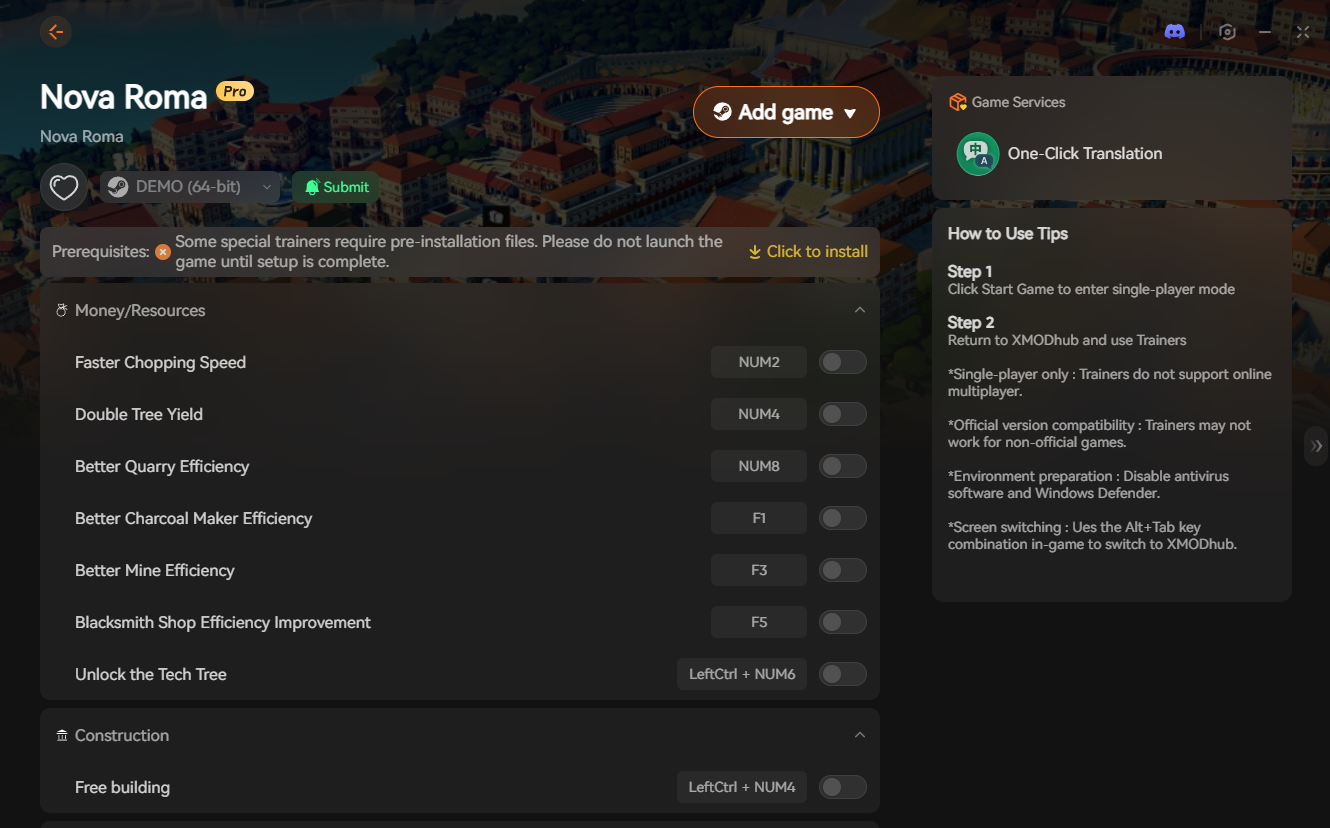
- Instant Resource Spawner: Open our intuitive in-game overlay and bypass the production chain entirely. Click “Add 1,000 Wine” or “Add 5,000 Weapons,” and the finished goods will instantly populate in your Storehouses, ready for Patrician consumption or port export.
- Instant Crafting Speed: If you still want to run the factories but hate the waiting time, toggle the “Fast Craft” modifier. Your Kilns, Wineries, and Smelters will instantly process raw materials into finished goods the exact millisecond they are delivered to the building.
- Ignore Blueprint Costs (Free Building): Need to build ten Wineries but lack the stone? Turn on “Free Building” mode to place massive industrial infrastructure anywhere on the map for zero Denarii and zero raw materials.
- Max Storage Hack: Lock your Granaries and Storehouses at 100% capacity permanently, ensuring your citizens never experience a shortage again, even if your supply lines are completely broken.
Step-by-Step: How to Get Started
- Download XMODhub: Get the secure, ad-free PC client directly from our official website.
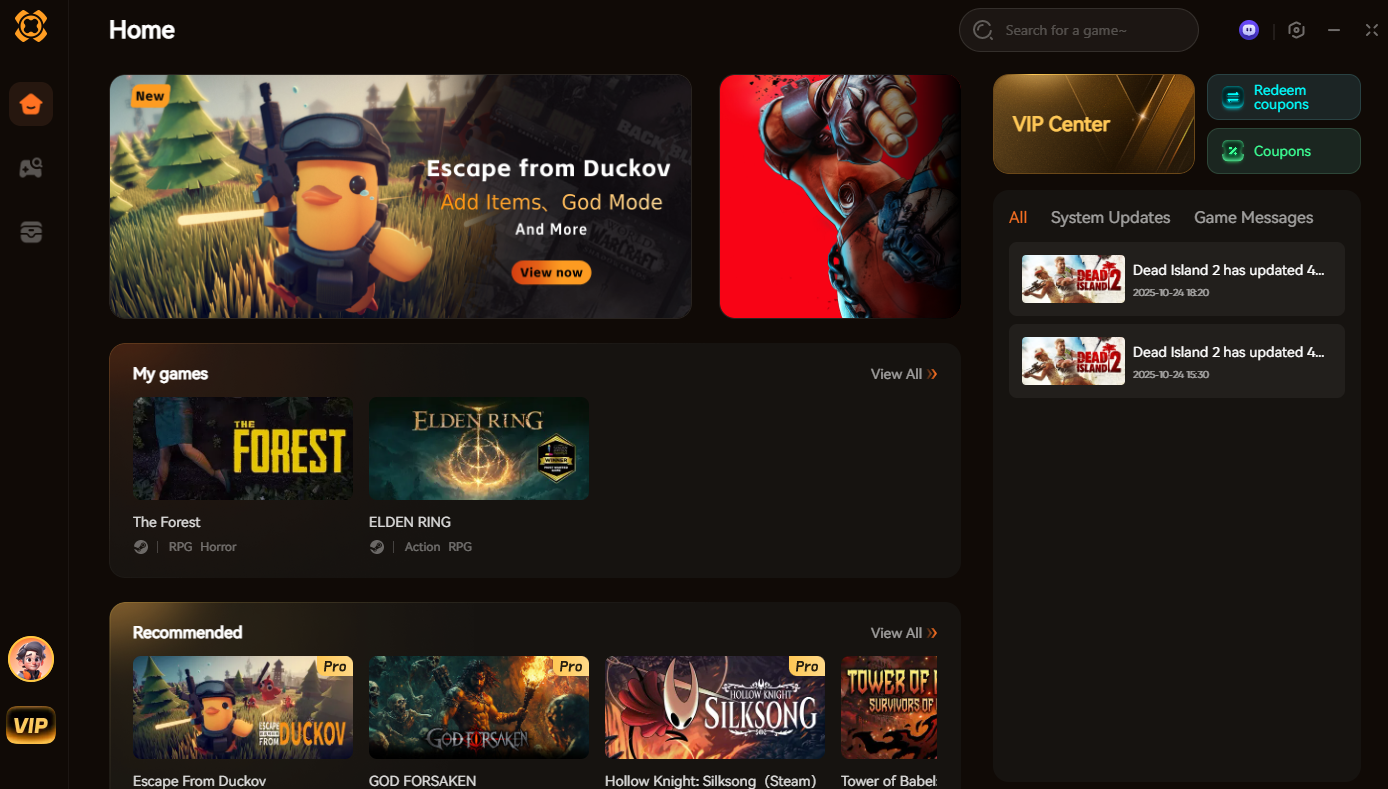
- Auto-Detect Game Path: Launch the app. It will automatically detect your Nova Roma installation folder and map out the Unity memory addresses safely.
- Activate the Trainer: Launch the game directly through the XMODhub dashboard. Once your city loads, press our designated hotkey (Default: F4) to open the in-game Spawner and flood your empire with premium goods instantly.
Frequently Asked Questions (FAQ)
Q: Why are my factories showing a “Missing Materials” warning even though I have the raw resources?
A: This is purely a logistics failure. The raw materials exist, but they are sitting in a Storehouse that is too far away. Alternatively, you do not have enough unassigned laborers (haulers) and Ox-Carts to physically move the items from the storage to the factory. Build Cart Depots closer to your factories.
Q: Can I import raw materials instead of extracting them myself?
A: Yes. You can set your Trade Port to buy raw Clay, Grapes, or Iron Ore from visiting merchants. However, this is very expensive. It is almost always better to extract raw materials locally and only use the port to export finished, high-value goods like Weapons and Wine.
Q: Do production buildings cause negative desirability in Nova Roma?
A: Yes. Heavy industries like Kilns, Smelters, and Charcoal Burners generate immense noise and filth. Never place them near your residential zones, or your housing will instantly downgrade, and your citizens will leave the city.
Q: Why are my farmers just standing in the fields not harvesting?
A: This happens when your local Granary is 100% full. If there is nowhere to store the freshly harvested Wheat, the farmers will stop working. You must build more storage or increase the consumption rate by building more Bakeries.
Conclusione
Il XMODhub PC Client provides a seamless, frustration-free bypass, letting you instantly spawn finished goods, ignore crafting times completely, and focus on the fun parts of city building. Take total control of your economy and build your Roman empire without limits.
Think Bigger: XMODhub is the ultimate gaming companion for PC players who want to define their own rules. With native support for over 5,000 titles, we provide industry-leading Visual Spawners, safe Save Managers, and God Mode toggles for the most demanding strategy and simulation games on the market.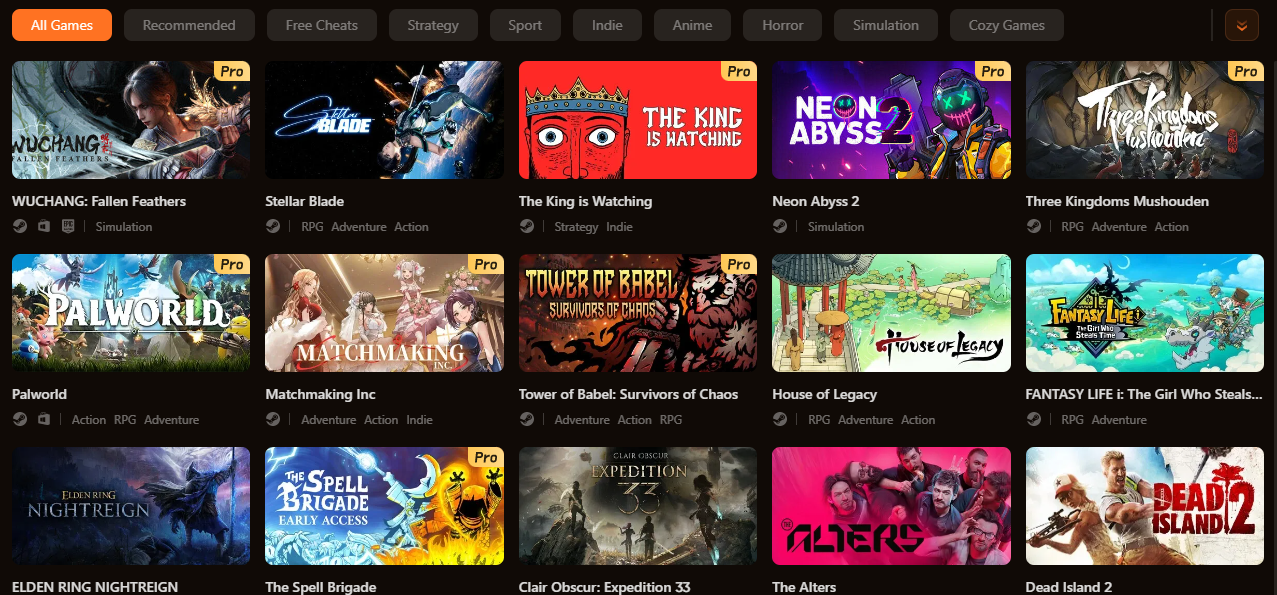

Sono un giocatore appassionato e uno scrittore di XMODhub, che si dedica a fornire le ultime notizie, consigli e approfondimenti sui giochi.
Collegatevi con me:
Profilo LinkedIn

 Nancy Miller